Making tomato sauce from fresh produce is rewarding, but peeling, coring, and removing seeds by hand can turn a simple batch into an all-day project. The right tomato press separates skins and seeds efficiently while preserving the flavorful pulp and juice.
This roundup compares 10 tomato presses, food mills, and electric sauce makers across manual, countertop, and commercial-style designs. Use the guide below to match capacity, cleanup, power, and budget to the way you process tomatoes.
Best 10 Tomato Presses Picks for 2026
High-Volume Electric Pick
OMRA Spremy Electric Tomato Strainer

- Handles up to 330 pounds per hour
- Separates skins and seeds automatically
- 1/4 HP, 225-watt motor with cooling fan
Best For: Large batches of tomato puree
Versatile Sauce-Making Choice
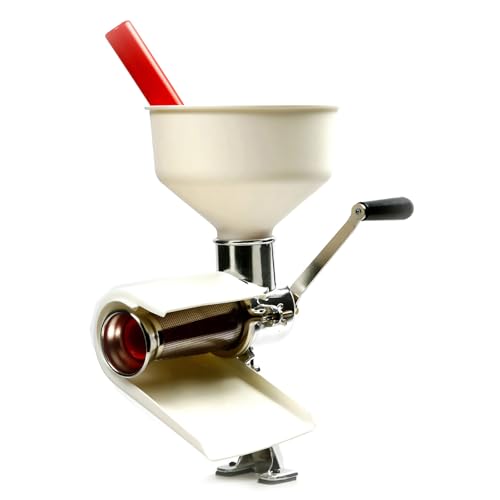
- 3-quart/95-ounce capacity
- Separates juice and pulp in one operation
- Optional screens expand its uses
Best For: Sauces, purees, fruits, and vegetables
Simple Manual Tomato Press

- No peeling, deseeding, or coring required
- Suction base helps stabilize the mill
- Includes stainless steel pusher
Best For: Fresh salsa, sauces, juice, and puree
Texture-Control Food Mill
OXO Good Grips Stainless Steel Mill

- Three discs for fine, medium, and coarse textures
- Non-slip legs fit pots up to 11 inches
- 2.3-quart capacity with foldable legs
Best For: Adjustable purees and sauces
Versatile Hand-Crank Pick

- 1.3mm tomato and apple screen included
- Clamp fits countertops 3/4 to 2-1/8 inches thick
- Optional electric motor available separately
Best For: Multi-purpose home sauce and puree making
Large-Hopper Manual Press
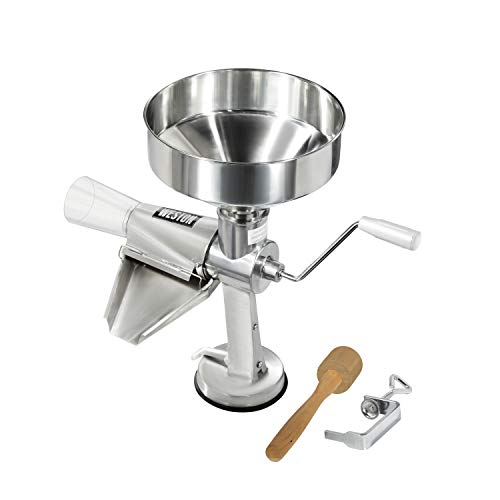
- One-gallon hopper for larger batches
- Stainless steel hopper and components
- Suction-cup and C-clamp mounting system
Best For: Manual batch tomato sauce and puree processing
Electric Multi-Function Machine

- Combines tomato straining with meat grinding
- Includes three cutting plates and multiple kits
- Reverse function and non-slip feet aid operation
Best For: Home cooks needing an electric multi-purpose appliance
Versatile Manual Pick

- Three discs for varied textures
- Sturdy, dishwasher-safe stainless steel
- Hooks and silicone grips improve stability
Best For: Small-batch sauces, purées, jams, and mashed foods
Batch-Friendly Electric Pick

- 250-watt motor with two speeds
- One-gallon hopper for larger batches
- Three screens for fine to chunky results
Best For: Preserving harvests and making sauces, purées, jellies, and salsa
High-Capacity Powerhouse
VBENLEM Electric Tomato Strainer

- 370-watt pure copper motor
- 304 stainless steel food-contact parts
- Large funnel and adjustable sauce trough
Best For: High-volume tomato sauces, ketchup, and fruit jams
High-Volume Electric Pick – OMRA Spremy Electric Tomato Strainer
For shoppers comparing tomato presses, the OMRA Spremy stands out as a high-capacity electric option. Its 1/4 HP motor and masticating-style 110 RPM auger automatically separates tomato skins and seeds from fresh or cooked tomatoes.
Best For: Large batches of tomato puree and shoppers who prefer powered processing.
Pros:
- Processes up to 330 pounds of tomatoes per hour.
- Automatically separates puree from seeds and skins.
- Uses a stainless steel hopper, die-cast metal housing, and food-grade nylon auger.
- Cooling fan supports the 225-watt motor.
Cons:
- Its 220-volt corded design may not suit every kitchen setup.
- Focused on powered straining rather than a broad range of manual food-mill textures.
The OMRA is the strongest fit here for frequent harvest processing, especially when speed and hands-off separation matter more than compact manual operation.
Versatile Sauce-Making Choice – Norpro 1951 Sauce Master
The Norpro 1951 is a practical choice among tomato presses for cooks who want one strainer for vegetables, fruits, and purees. It forces food through a chrome-plated steel screen while separating juice and pulp in one operation.
Best For: Home cooks making sauces, purees, and other strained fruit or vegetable preparations.
Pros:
- Includes a standard fine mesh screen and spiral.
- Has a 3-quart/95-ounce capacity.
- Additional berry, pumpkin, and salsa screens are available separately.
- Includes a recipe and instruction booklet.
Cons:
- Extra screens require separate purchase.
- Its listed dimensions are relatively substantial for a countertop strainer.
The Sauce Master offers useful flexibility for cooks who want tomato processing plus broader straining capability, with accessory screens available for specialized tasks.
Simple Manual Tomato Press – Suction-Mount Tomato Strainer
This manual tomato strainer is a straightforward option for shoppers seeking tomato presses without peeling, deseeding, or coring first. Its suction base helps secure the food mill while skins and seeds exit to the side and juice flows into the tray.
Best For: Home cooks making fresh tomato juice, puree, salsa, and pasta sauce in smaller batches.
Pros:
- Processes tomatoes without pre-peeling, deseeding, or coring.
- Sturdy suction mount helps keep the mill in place.
- Includes a stainless steel pusher.
- Suitable for straining, juicing, pureeing, and homemade salsa.
Cons:
- The plastic construction may feel less substantial than metal-bodied models.
- Manual operation is less suited to very large harvests.
Its compact, task-focused design makes it a convenient entry point for fresh tomato recipes, particularly when easy setup and basic straining are the priorities.
Texture-Control Food Mill – OXO Good Grips Stainless Steel Mill
The OXO Good Grips Food Mill is a useful alternative to specialized tomato presses when texture control is important. Its stainless steel bowl handles hot foods, and three grinding discs produce fine, medium, or coarse results for purees and sauces.
Best For: Cooks who want adjustable textures for tomato sauces, purees, and other hot foods.
Pros:
- Includes three stainless steel grinding discs.
- Non-slip legs fit bowls and pots up to 11 inches in diameter.
- Spring-loaded lever supports disc changes and disassembly.
- Legs fold for storage, and the mill is dishwasher safe.
Cons:
- It is a general-purpose food mill rather than an automatic tomato skin-and-seed separator.
- The approximately 2.3-quart capacity is smaller than the OMRA’s stated processing capacity.
Choose the OXO when you value multiple puree textures and stable placement over a pot more than high-volume, specialized tomato processing.
Versatile Hand-Crank Pick – Johnny Apple Sauce Maker
If you want tomato presses that can handle more than one type of produce, the Johnny Apple Sauce Maker is a flexible option. Its 1.3mm screen separates skins and seeds for sauces, purees, juices, jams, baby food, and more, while the clamp mount provides a stable base on suitable countertops.
Best For: Home cooks who want a versatile manual strainer for tomato sauce and other fruit and vegetable preparations.
Pros:
- Includes an apple/tomato screen, standard spiral, and instruction manual.
- Separates skins and seeds without requiring peeling or coring first.
- Clamp mounts to countertops from 3/4 to 2-1/8 inches thick.
- Can be converted to optional electric-motor operation.
Cons:
- Electric motor is sold separately.
- Additional screens for salsa, pumpkin, and berries cost extra.
- Manual cranking may require more effort for larger batches.
This is a strong all-purpose choice if versatility matters more than built-in electric operation. Its included fine screen and secure clamp make it ready for tomato sauce, while the accessory ecosystem expands what it can process.
Large-Hopper Manual Press – Weston Metal Tomato Strainer
Among tomato presses, the Weston Metal Tomato Strainer stands out for its one-gallon hopper and stainless steel construction. Its dual-mount system can attach to a range of flat surfaces, making it practical for processing tomato sauce, jams, preserves, salsa, and other soft produce in the kitchen or garden.
Best For: Cooks who want a stainless steel manual strainer with a generous hopper for larger batches.
Pros:
- One-gallon hopper helps accommodate larger quantities.
- Dual mounting uses a suction cup and C-clamp for flexible setup.
- Includes a stomper and 1.5mm multipurpose screen.
- Splash guard and directed chute help reduce mess.
Cons:
- Additional screens require a separately sold accessory kit.
- Manual operation may be less convenient than an electric machine.
The Weston is a practical pick for batch-oriented sauce making. The large hopper, smooth-turning handle, and stainless steel components support efficient manual processing, while the dual mount gives you more flexibility about where to use it.
Electric Multi-Function Machine – AIRMSEN Tomato Sauce Press
If you prefer electric tomato presses with added kitchen functionality, the AIRMSEN combines tomato sauce processing with meat grinding, sausage making, and kibbeh preparation. Its reverse function is designed to help clear jams, and the detachable components make cleanup more manageable, though hand washing is recommended.
Best For: Home kitchens that want one electric appliance for tomato sauce and several meat-preparation tasks.
Pros:
- Combines tomato straining, meat grinding, sausage making, and kibbeh preparation.
- Includes a tomato strainer kit, three cutting plates, blades, and preparation accessories.
- Reverse function helps address ingredient jams.
- Non-slip feet and a safety-lock knob support stable operation.
Cons:
- Parts are not dishwasher safe; hand washing is recommended.
- Requires more counter space than a dedicated manual strainer.
- Its tomato-pressing function is part of a broader appliance rather than a single-purpose press.
The AIRMSEN makes the most sense when you will use its multiple functions regularly. It offers electric convenience and a tomato strainer attachment, but shoppers seeking a simple, dedicated press may prefer a manual model.
Versatile Manual Pick – Stainless Steel Food Mill
For shoppers comparing tomato presses, this manual stainless steel food mill is a flexible option for small-batch sauces, purées, jams, and mashed foods. Three interchangeable discs let you choose a finer or coarser texture without relying on electricity.
Best For: Home cooks who want a compact, manually operated tomato press for sauces and other soft foods.
Pros:
- Includes three milling discs for different textures.
- Stainless steel construction is sturdy and dishwasher safe.
- Dual hooks and silicone-covered grip help stabilize the mill over a bowl.
- Includes a multifunctional spoon for pressing and scraping during milling.
Cons:
- Manual operation requires more effort than an electric tomato strainer.
- The supplied notes do not indicate the bowl size or batch capacity.
This food mill is a practical choice when versatility and easy cleanup matter more than high-volume processing. Its three discs make it useful beyond tomatoes, while the manual design keeps operation straightforward.
Batch-Friendly Electric Pick – Weston Deluxe Tomato Strainer
This electric tomato strainer is designed for shoppers who want tomato presses to handle sauce-making and preserving with less manual work. Its 250-watt motor, one-gallon hopper, and included screens support several textures and soft-food applications.
Best For: Home preservers processing garden harvests or bulk produce into sauces, purées, jellies, and salsa.
Pros:
- Separates tomato skins and seeds without coring.
- One-gallon hopper supports larger batches.
- Two speeds include reverse operation to help prevent jamming.
- Includes 1.5mm, 3mm, and 6mm stainless steel screens.
Cons:
- Requires a 120-volt AC power source.
- Its 14-by-12-by-17-inch footprint may need dedicated counter space.
With multiple screens and a reverse function, the Weston offers useful control for recurring sauce and preserving projects. It is better suited to batch preparation than occasional single-tomato use.
High-Capacity Powerhouse – VBENLEM Electric Tomato Strainer
Among tomato presses, the VBENLEM is aimed at demanding sauce-making jobs rather than occasional kitchen use. Its 370-watt pure copper motor, large funnel, and stainless steel food-contact components are designed for substantial tomato and fruit processing.
Best For: High-volume home processing or commercial-style preparation of tomato sauces, ketchup, and fruit jams.
Pros:
- 370-watt pure copper motor supports powered milling.
- Food-contact parts use 304 stainless steel and are easy to disassemble.
- Nine-inch funnel accommodates generous feeding.
- Adjustable discharge trough helps direct sauce and reduce splashing.
Cons:
- At 22 pounds, it is substantially heavier than a manual food mill.
- Its 110-volt electric design is less portable than nonpowered options.
- The larger commercial-style build may be excessive for occasional small batches.
This machine makes the most sense when throughput and powered operation are priorities. The stainless steel construction, adjustable trough, and large funnel favor repeated sauce-making sessions, though the size and weight call for a dedicated workspace.
How We Picked These Tomato Presses
We focused on the features that matter during real sauce-making sessions: separation performance, throughput, construction, feeding capacity, ease of cleaning, and operating effort. The selection includes hand-crank strainers for occasional batches, food mills for versatile kitchen use, and electric machines for frequent or high-volume processing.
Because these tools vary widely, we considered intended use rather than treating every model as a direct substitute. A compact food mill may be more useful for small portions and mashed foods, while a powered tomato strainer can save substantial time during harvest season.
Quick Comparison
| Best For | Recommended Type | What to Look For |
|---|---|---|
| Small kitchen batches | Manual food mill | Comfortable handle, stable support, interchangeable discs |
| Regular home canning | Hand-crank tomato strainer | Strong clamp, generous hopper, durable screen and auger |
| Less manual effort | Electric tomato press | Motor power, continuous-feed design, removable parts |
| Large harvests | High-capacity electric mill | Stainless-steel construction, high throughput, overload protection |
Key Buying Factors for Tomato Presses
Manual or Electric Operation
Manual presses are usually simpler, quieter, and easier to store. They work well for occasional batches but require steady cranking. Electric models reduce physical effort and are better suited to repeated processing, although they cost more and need access to an outlet.
Capacity and Throughput
Check the hopper size and stated processing rate, but treat manufacturer capacity figures as best-case estimates. A larger hopper and continuous-feed design help when processing several pounds of tomatoes at once. For small meals, an oversized commercial machine may add unnecessary storage and cleanup.
Separation Quality
Look for a well-designed screen and adjustable or appropriately sized auger. Fine screens generally produce smoother sauce, while the ability to change screens can make a machine more useful for different produce. Even the best press may require a second pass for maximum yield.
Materials and Cleanup
Stainless steel components resist staining and are preferable for frequent use. Confirm which parts detach, whether they are dishwasher safe, and how easily pulp, seeds, and skins can be cleared from the screen. A tool that is difficult to clean may discourage you from using it.
Stability and Safety
For hand-crank models, a secure clamp or broad base prevents sliding. Electric units should have stable feet, protected moving parts, and clear instructions for avoiding jams. Never force hard or oversized pieces into a powered hopper.
Who Should Buy Which Tomato Presses?
Choose a Manual Food Mill If You Want Versatility
A food mill is the practical choice for cooks who want to process tomatoes as well as potatoes, apples, soups, and other soft foods. It is especially suitable for small servings and does not require electricity.
Choose a Hand-Crank Press for Home Canning
A clamp-based strainer offers a useful balance of cost, control, and capacity. It is a good fit for gardeners who process seasonal batches but do not need commercial-level speed.
Choose an Electric Press for Frequent or Large Batches
If you make sauce regularly, preserve a substantial harvest, or want to minimize repetitive cranking, an electric model is likely the better investment. Prioritize durable construction, easy disassembly, and a throughput that matches your typical workload rather than simply choosing the highest advertised number.