The best doughnut makers make it easy to prepare consistent homemade treats without deep-frying or complicated equipment. This roundup compares compact appliances for family kitchens alongside higher-capacity machines for frequent or commercial-style use.
Consider capacity, heating performance, plate design, cleanup, and the type of doughnuts you want to make before choosing. The right model depends as much on batch size and storage space as on price.
Best 10 Doughnut Makers Picks for 2026
Best Kid-Friendly Pick

- Makes 7 mini doughnuts in minutes
- Nonstick surface simplifies cleanup
- Compact design with recipe support
Best For: Families, kids, and quick snack preparation
Most Versatile Pick
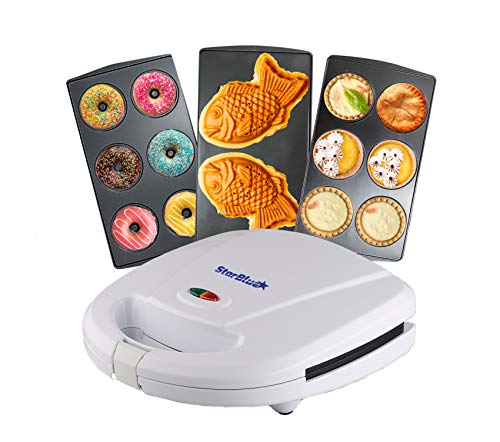
- Three interchangeable cooking plate sets
- Makes doughnuts, mini pies, and taiyaki
- Detachable nonstick plates ease cleanup
Best For: Multi-purpose dessert baking and family variety
Best for Small Spaces

- Bakes 7 mini doughnuts quickly
- Nonstick plates wipe clean easily
- Stores upright in compact spaces
Best For: Apartments, dorms, RVs, and small kitchens
Best for Larger Mini Doughnuts

- Makes six 3-inch doughnuts
- Nonstick coating eases cleanup
- Power and ready lights guide baking
Best For: Larger mini doughnuts for families and gatherings
Best for Tiny Treats

- Makes 1.93-inch bite-sized doughnuts
- Includes a complete decorating accessory set
- Cool-touch, nonstick design with indicator lights
Best For: Snack time, brunches, and entertaining
Best for Easy Family Batches
Baker's Friend Mini Donut Maker

- Makes 12 mini doughnuts per batch
- Accepts cake, brownie, and other batters
- PFOA-free nonstick surfaces ease cleanup
Best For: Families, children, and casual entertaining
Best for Commercial Production

- Produces up to 250 mini doughnuts per hour
- Automates forming, frying, flipping, and counting
- 304 stainless-steel body with safety controls
Best For: Cafes, bakeries, and dessert shops
Best for Family Baking
Compact 7-Slot Mini Doughnut Maker

- Makes up to 7 mini doughnuts in 4–6 minutes
- Non-stick plates support easy release
- Compact 750W design for smaller kitchens
Best For: Families and kids who enjoy quick homemade treats
Best for Small Batches

- Makes 2 doughnuts in a few minutes
- Double-sided cast-aluminum heating
- Includes brush and scraper
Best For: Small households making fresh doughnuts in limited quantities
Best for High-Volume Mini Treats
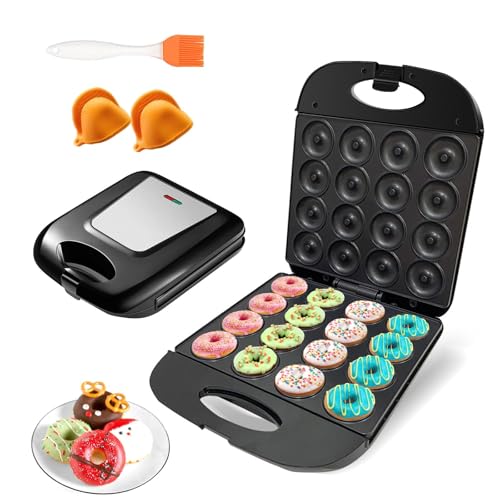
- Makes 16 mini doughnuts per plate
- 1–5 minute baking time
- Includes mitts and oil brush
Best For: Families and entertaining with larger batch needs
Best Kid-Friendly Pick – Dash Mini Donut Maker
For quick, family-friendly doughnut makers, the Dash Mini Donut Maker is a straightforward option. Its nonstick surface makes seven mini doughnuts at a time, while the compact design suits everyday snacks, parties, and small kitchens.
Best For: Families, kids, and anyone who wants simple mini doughnuts with minimal cleanup.
Pros:
- Makes seven mini doughnuts in minutes.
- Nonstick cooking surface is easy to wipe clean.
- Includes a recipe guide and recipe database access.
- Compact 2.2-pound design takes up little counter space.
Cons:
- Produces mini doughnuts rather than larger doughnuts.
- Has one setting and does not include interchangeable plates.
Choose this model if ease of use and kid-friendly baking matter more than versatility. Its 760-watt design is focused specifically on quick mini doughnuts.
Most Versatile Pick – StarBlue 3-in-1 Dessert Maker
The StarBlue 3-in-1 Dessert Maker stands out among doughnut makers for its interchangeable plates. It can prepare six mini doughnuts, six bite-size pies or quiches, and two taiyaki, giving one compact appliance several dessert uses.
Best For: Cooks who want mini doughnuts plus pie, quiche, and taiyaki options.
Pros:
- Includes three sets of changeable plates.
- Detachable nonstick plates release food easily and simplify cleaning.
- Cool-touch housing, locking system, non-slip feet, and indicator lights support convenient use.
- Offers three cooking functions in a compact white design.
Cons:
- Makes six mini doughnuts per batch, fewer than some dedicated models.
- At 4.8 pounds, it is heavier than the simplest mini doughnut makers.
- Requires storing multiple interchangeable plates.
This is the better choice when variety is important. Its additional plates add flexibility, though buyers focused only on doughnuts may prefer a simpler dedicated appliance.
Best for Small Spaces – CucinaPro Mini Donut Maker
The CucinaPro Mini Donut Maker is a practical choice for shoppers comparing compact doughnut makers. It bakes seven small doughnuts in minutes, uses nonstick cooking plates, and can stand upright for storage in apartments, dorms, small kitchens, or RVs.
Best For: Small-space kitchens, quick breakfasts, and DIY decorating stations.
Pros:
- Bakes seven bite-size doughnuts in minutes.
- Nonstick plates support easy release and quick wipe-down cleaning.
- Upright-storage design helps reduce cabinet and counter demands.
- Includes a recipe guide with several flavor ideas.
Cons:
- Designed for small doughnuts rather than full-size portions.
- The supplied notes do not specify wattage, warranty, or indicator-light features.
Its strongest advantage is space-conscious storage paired with a seven-doughnut capacity. Consider it for casual home baking when compactness is a priority.
Best for Larger Mini Doughnuts – Baker’s Friend 6-Count Maker
Among doughnut makers, the Baker’s Friend Mini Donut Maker is aimed at shoppers who want larger mini treats. Its six cavities make 3-inch doughnuts, and the 1,000-watt appliance includes ready and power indicator lights, a brush, and a recipe booklet.
Best For: Families and gatherings where 3-inch doughnuts are preferable to smaller bite-size versions.
Pros:
- Makes six larger 3-inch doughnuts per batch.
- Nonstick coating supports straightforward cleanup.
- Red and green lights indicate power and baking readiness.
- Includes a brush and recipe booklet.
Cons:
- Makes six doughnuts per batch, fewer than seven-count models.
- Its 11.2-inch depth may require more storage space.
- Only one setting is listed.
This model makes sense when portion size matters more than maximum batch count. The aqua finish and compact appliance format also make it a practical gift-oriented option.
Best for Tiny Treats – DSP Mini Donut Maker
For shoppers comparing doughnut makers for small snacks, the DSP Mini Donut Maker focuses on bite-sized 1.93-inch treats. Its indicator lights, nonstick coating, cool-touch exterior, and included decorating tools make it a practical option for casual home baking.
Best For: Families, entertaining, and snack-sized homemade doughnuts.
Pros:
- Makes compact mini doughnuts in about three minutes.
- Includes piping bags, spatula, whisk, tongs, and cooking brush.
- Nonstick, scratch-resistant surfaces and a wipe-clean design simplify cleanup.
- Cool-touch exterior and ready-to-bake indicator light support easier handling.
Cons:
- The doughnuts are much smaller than standard doughnuts.
- Its 16-doughnut set format may not suit users seeking larger portions.
This is a compact, accessory-rich choice for playful mini doughnuts rather than full-size baking. Choose it if small portions and straightforward operation matter most.
Best for Easy Family Batches – Baker's Friend Mini Donut Maker
Among doughnut makers for everyday home use, the Baker’s Friend Mini Donut Maker is designed to produce 12 mini doughnuts per batch. Its simple batter-based operation, double nonstick surfaces, and compact footprint suit quick breakfasts, desserts, and decorating projects.
Best For: Families, children, and hosts who want quick batches of mini doughnuts.
Pros:
- Bakes 12 mini doughnuts in a matter of minutes.
- Works with cake mix, brownie mix, or other batters.
- Double-sided PFOA-free nonstick surfaces support even cooking and easier cleanup.
- Compact design takes up minimal countertop space.
Cons:
- It makes mini doughnuts rather than standard-size doughnuts.
- The supplied notes do not specify a cooking timer or temperature-control feature.
This model keeps the process approachable and makes a useful batch size for households or gatherings. It is a strong fit when simplicity, quick output, and easy cleanup outweigh advanced controls.
Best for Commercial Production – FOHERE Automatic Donut Maker
For businesses evaluating commercial doughnut makers, the FOHERE combines forming, frying, flipping, collecting, counting, and output in one automated machine. Its 1,750-watt system, 3-liter hopper, four-row molds, and stainless-steel construction are built for high-volume mini doughnut production.
Best For: Cafes, bakeries, dessert shops, buffets, hotels, and other commercial kitchens.
Pros:
- Produces up to 250 40 mm mini doughnuts per hour.
- Automates forming, frying, flipping, collecting, counting, and outputting.
- 304 food-grade stainless-steel construction is durable and easy to maintain.
- Includes temperature control, adjustable frying speed, overheating protection, and double-switch safety.
Cons:
- Its 35.2-pound weight and larger footprint are excessive for most home kitchens.
- Operation requires oil in the tank before startup.
- Its commercial capacity and 1,750-watt power may be more than occasional users need.
This is a production-focused machine rather than a countertop home gadget. Its automated workflow and high hourly capacity make sense for businesses that regularly need consistent mini doughnut output.
Best for Family Baking – Compact 7-Slot Mini Doughnut Maker
If you want doughnut makers that make family baking simple, this compact KEINVE model produces up to seven mini doughnuts in about 4–6 minutes. Its non-stick plates and small footprint suit quick breakfasts, snacks, and decorating activities.
Best For: Families and kids who want quick, homemade mini doughnuts with easy cleanup.
Pros:
- Bakes up to seven mini doughnuts in 4–6 minutes.
- Non-stick plates help doughnuts release easily.
- Compact 750-watt design fits smaller kitchens.
- Supports creative decorating with icing and sprinkles.
Cons:
- Designed for mini doughnuts rather than full-sized doughnuts.
- Its seven-slot capacity is smaller than the 16-hole models in this roundup.
Choose this model if convenience, compact storage, and family-friendly baking matter more than maximum batch size. The straightforward design is especially suitable for occasional treats and hands-on decorating.
Best for Small Batches – Two-Hole Doughnut Machine
Among doughnut makers, this two-hole machine is geared toward small batches and straightforward operation. Double-sided cast-aluminum heating plates warm evenly, while the included brush and scraper help with preparation and removal.
Best For: Individuals, couples, or small households making a few doughnuts at a time.
Pros:
- Prepares two doughnuts in just a few minutes.
- Double-sided heating promotes even cooking and browning.
- PFOA-free non-stick surfaces help reduce sticking.
- Includes an oil brush and scraper.
Cons:
- Two-hole capacity is limited for larger groups.
- The plates become very hot during and after use.
- The manufacturer notes that the panel connection may feel loose by design.
This is a practical pick when you prefer small, fresh batches and useful basic accessories. Its limited capacity makes it less suitable for entertaining or high-volume baking, and careful handling is important because the unit gets hot.
Best for High-Volume Mini Treats – 16-Hole Doughnut Maker
For shoppers comparing doughnut makers by output, this 16-hole electric machine is built for larger mini-doughnut batches. Its 1,400-watt double-sided heating system cooks the included approximately 1.97-inch portions in about 1–5 minutes, and the package includes mini oven mitts and an oil brush.
Best For: Families, entertaining, and users who want to produce many mini doughnuts quickly.
Pros:
- Produces 16 mini doughnuts per plate.
- Double-sided heating supports quick, even cooking.
- Non-stick, scratch-resistant coating helps with release.
- Includes mini oven mitts, an oil brush, and a user guide.
Cons:
- The 13.3-inch depth and 11.4-inch width require more counter space.
- It makes mini doughnuts rather than full-sized doughnuts.
- Its 1,400-watt power rating is higher than the other listed models.
This model stands out when batch size and speed are the main priorities. It takes more room than compact alternatives, but the 16-hole plate can be useful for parties, family baking, or frequent homemade snacks.
How We Picked the Best Doughnut Makers
We organized these Doughnut Makers around the features that matter most in everyday use: doughnut capacity, appliance size, nonstick cooking surfaces, heating design, controls, cleanup, and intended workload. The selection includes small electric models that bake several mini doughnuts at a time, combination dessert makers with added versatility, and high-output equipment designed for parties, events, or commercial settings.
Because product specifications and included accessories can vary, confirm the current listing before buying. Pay particular attention to dimensions, wattage, plate configuration, and whether the machine bakes or fries doughnuts.
Quick Comparison
- Best for most families: A compact seven-doughnut maker offers a useful balance of speed, footprint, and serving size.
- Best for larger batches: Models with 12 or 16 cavities reduce the number of cooking cycles for gatherings.
- Best for versatility: A 3-in-1 dessert maker or waffle-cake model can handle more than doughnuts.
- Best for frequent production: A commercial automatic fryer with a hopper and multiple rows is better suited to high-volume output.
- Best for simple portions: A two-doughnut appliance may suit occasional use, couples, or small kitchens.
Key Buying Factors for Doughnut Makers
Capacity and Batch Speed
Mini Doughnut Makers commonly produce between six and 16 pieces per cycle. A smaller cavity count saves counter space, while a larger one is more practical for children’s parties and entertaining. Check advertised cooking time as well as capacity; several short cycles can still take longer than expected.
Baked Versus Fried Results
Most home machines bake batter between heated plates, producing lighter, cake-style doughnuts with little or no added oil. Commercial fryers produce a different texture and may require more ventilation, cleaning, and safety precautions.
Plate Design and Cleanup
Nonstick plates help release doughnuts and simplify cleanup, but they should still be treated gently with silicone or wooden utensils. Look for clear overflow space, easy-to-wipe housing, and removable plates if available.
Size, Controls, and Safety
Measure your storage area before ordering. Indicator lights are sufficient for simple appliances, while adjustable temperature controls offer more flexibility across recipes. Cool-touch handles, stable feet, cord storage, and overheat protection are useful practical features.
Who Should Buy Which Doughnut Makers?
Choose a compact seven-cavity model if you want quick breakfasts, occasional desserts, or an easy appliance for children to use with supervision. Choose a 12- or 16-cavity model if you regularly serve groups and want fewer repeat batches. Choose a multifunction machine if storage space is limited and you also want waffles or other desserts. Choose a two-cavity design for modest portions and infrequent baking. Finally, choose a commercial automatic unit only when the higher capacity, larger footprint, and added operating requirements match your workload.