Small-batch sauce, jam, and puree production demands equipment that can separate skins and seeds quickly without creating unnecessary cleanup or labor. The right food strainer can improve consistency while helping your team process more produce per shift.
We compared 10 manual and electric options for capacity, power, materials, versatility, ease of use, and suitability for commercial-style kitchen workflows. The selections range from compact countertop tools to higher-throughput machines for growing operations.
Best 10 Food Strainer Machines for Small Businesses Picks for 2026
Best Clamp-Mount Pick
Johnny Apple Sauce Maker Model 250

- 1.3 mm screen separates skins and seeds
- Clamp fits countertops 3/4 to 2-1/8 inches thick
- Optional electric motor available separately
Best For: Small-batch sauces, purees, jams, and seasonal produce prep
Best 3-Quart Manual Option
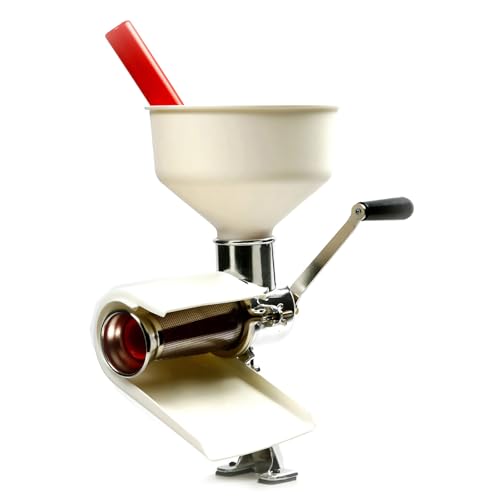
- 3-quart, 95-ounce listed capacity
- Separates juice and pulp in one operation
- Optional berry, pumpkin, and salsa screens
Best For: Moderate-batch manual sauce and puree preparation
Best High-Output Electric Pick
OMRA Spremy Electric Tomato Strainer Model 850

- Processes up to 330 pounds of tomatoes per hour
- 1/4 HP motor with cooling fan
- Requires corded 220-volt power
Best For: High-volume tomato puree production
Best Texture-Control Food Mill
Stainless Steel Rotary Food Mill with 3 Discs

- Coarse, medium, and fine discs included
- Useful for sauces, purees, soups, and mashed potatoes
- Dishwasher-safe stainless steel design
Best For: Small-batch prep requiring multiple food textures
Best Electric Capacity

- Up to 88 lb./hour for purees
- Four screens for varied textures
- 304 stainless steel construction
Best For: High-volume sauce, puree, and canning work
Best Mixer Attachment
KitchenAid Fruit and Veg Strainer

- Works with KSMFGA Food Grinder
- Dishwasher-safe parts
- Includes five accessory components
Best For: Businesses already using a compatible KitchenAid grinder
Best Manual Value
Stainless Steel Rotary Food Mill

- Three milling discs for varied textures
- Stable dual-hook bowl attachment
- Dishwasher-safe stainless steel design
Best For: Lower-volume sauce, jam, and puree preparation
Best Electric All-Rounder
Weston Deluxe Electric Tomato Strainer

- 250-watt motor with forward and reverse speeds
- One-gallon hopper for larger processing batches
- Three screens for smooth or chunky results
Best For: Small-batch sauce, puree, jelly, and salsa production
Best Manual Stainless-Steel Option
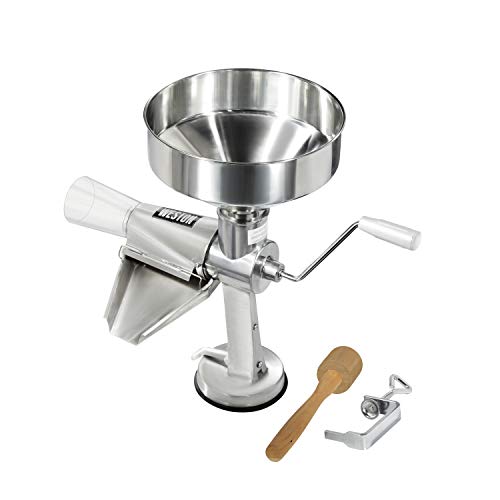
- Manual design requires no motor or electrical power
- One-gallon stainless steel hopper
- Suction-cup and C-clamp mounting options
Best For: Hands-on tomato sauce and preserve production
Best High-Volume Electric Pick

- 370-watt motor for large-batch processing
- Stainless-steel food-contact components
- Tool-free disassembly for easier cleanup
Best For: Frequent, high-volume sauce, puree, jam, and tomato processing
Best Clamp-Mount Pick – Johnny Apple Sauce Maker Model 250
For small businesses seeking food strainer machines for small businesses with flexible batch-prep needs, the Johnny Apple Sauce Maker Model 250 is a versatile manual option. Its 1.3 mm apple/tomato screen separates skins and seeds from produce for sauces, purees, juices, jams, soups, and baby foods.
Best For: Small-scale sauce, puree, jam, and seasonal produce preparation where countertop space and mounting flexibility matter.
Pros:
- Secure clamp mounts to countertops from 3/4 to 2-1/8 inches thick.
- Includes an apple/tomato screen, standard spiral, and instructions.
- Can be hand-cranked or upgraded with an optional electric motor.
- Cast aluminum body, stainless steel screens, BPA-free plastic parts, and a stated five-year warranty.
Cons:
- The electric motor is sold separately.
- The included screen is specialized for fine straining; additional screens cost extra.
- Manual operation may be slower for high-volume production.
This is a practical choice when a business wants one compact machine that can handle several soft-produce applications. Its clamp design and optional motor make it adaptable, though larger operations may prefer a dedicated electric unit.
Best 3-Quart Manual Option – Norpro 1951 Sauce Master
The Norpro 1951 Sauce Master is a straightforward choice among food strainer machines for small businesses that need manual fruit and vegetable processing. Its 3-quart capacity and chrome-plated steel screen separate juice and pulp in one operation.
Best For: Small commercial kitchens and home-based food businesses making sauces, purees, and strained fruit or vegetable preparations in moderate batches.
Pros:
- Offers a listed 3-quart, or 95-ounce, capacity.
- Automatically separates juice and pulp as food passes through the screen.
- Includes a fine mesh screen, standard spiral, recipe booklet, and instructions.
- Optional berry, pumpkin, and salsa screens expand its uses.
Cons:
- Additional screens are sold separately.
- Hand washing is specified, which may add cleanup time.
- Manual operation is less suited to very high-volume processing.
With its moderate capacity and included fine screen, the Sauce Master is a sensible middle ground for businesses that want more capacity than a basic food mill without moving to powered equipment. Consider the optional screens if your menu requires different textures or ingredients.
Best High-Output Electric Pick – OMRA Spremy Electric Tomato Strainer Model 850
For businesses comparing food strainer machines for small businesses that process tomatoes at scale, the OMRA Spremy Electric Tomato Strainer Model 850 offers powered separation. Its 1/4 HP motor extracts puree while separating seeds and skins, with a stated production rate of up to 330 pounds of tomatoes per hour.
Best For: Tomato-focused businesses needing fast, continuous puree production from fresh or cooked tomatoes.
Pros:
- Rated for production of up to 330 pounds, or 150 kg, of tomatoes per hour.
- Electric 1/4 HP motor runs at 110 RPM and includes a cooling fan.
- Die-cast metal housing and stainless steel hopper support a production-oriented design.
- Food-grade nylon auger uses a masticating-style rotation described as helping preserve enzymes.
Cons:
- It is specialized primarily for tomatoes, with apples also listed as a recommended use.
- Requires corded 220-volt power.
- Its higher output may be unnecessary for very small or occasional batches.
The OMRA is the strongest fit here for throughput-sensitive tomato processing. Before choosing it, verify that the worksite supports its 220-volt requirement and that the business can make use of its tomato-oriented capacity.
Best Texture-Control Food Mill – Stainless Steel Rotary Food Mill with 3 Discs
This stainless steel rotary food mill is a useful entry-level choice among food strainer machines for small businesses that need adjustable textures. Three interchangeable discs provide coarse, medium, and fine results for tomato sauce, applesauce, mashed potatoes, soups, jams, and soft cooked produce.
Best For: Small kitchens and food-prep businesses that value texture flexibility, simple manual operation, and easy storage.
Pros:
- Includes coarse, medium, and fine interchangeable grinding discs.
- Supports a wide range of soft-food applications, including sauces, purees, soups, and mashed potatoes.
- Stainless steel construction is described as dishwasher safe, stain resistant, and corrosion resistant.
- Disassembles for cleaning and has a handle hole for hanging storage.
Cons:
- Manual rotary operation may not suit high-volume production.
- It is designed for soft or cooked foods rather than heavy-duty processing.
- Its moderate size may limit batch capacity for larger orders.
The interchangeable discs make this food mill appealing when one finished texture is not enough. It is best suited to small batches and varied menus, while businesses with sustained commercial volume should consider a powered strainer.
Best Electric Capacity – VEVOR 800W Tomato Strainer
For small businesses needing food strainer machines for small businesses that can handle recurring sauce or puree work, the VEVOR electric tomato strainer offers steady motor power and a stated capacity of up to 88 pounds per hour. Its stainless steel screen separates peels and seeds in a single pass.
Best For: Small-batch commercial sauce making, puree production, and harvest-season canning.
Pros:
- Four interchangeable screens support sauces, jams, purees, salsa, and different textures.
- 304 stainless steel components resist fruit acids and wear.
- DC motor is designed for steady, lower-noise continuous operation.
- Guard cover helps reduce splatter, and removable parts simplify cleaning.
Cons:
- It is larger and more specialized than a manual food mill.
- The stated 800W maximum differs from the listed 300W rated power, so buyers should review the electrical specifications.
This is the strongest choice here for businesses prioritizing throughput and repeatable straining. The multiple screens add flexibility, while the electric drive reduces the manual effort involved in larger sauce batches.
Best Mixer Attachment – KitchenAid Fruit and Veg Strainer
Among food strainer machines for small businesses, this KitchenAid attachment is a compact option for operations that already use the compatible KitchenAid Food Grinder. It helps puree and strain fruits and vegetables for sauces, jams, baby food, and similar preparations.
Best For: KitchenAid-equipped businesses that need occasional or moderate fruit and vegetable straining without a separate electric machine.
Pros:
- Designed to work with the KSMFGA Food Grinder.
- Strains seeds while helping reduce preparation time.
- Dishwasher-safe parts make cleanup easier.
- Includes a cone, shield, splash lid, pusher, and removable tray.
Cons:
- The required KSMFGA Food Grinder is sold separately.
- It is not compatible with the discontinued FGA Food Grinder.
- As a manual attachment, it depends on the connected KitchenAid setup rather than having its own motor.
This attachment makes sense when counter space and equipment reuse matter more than standalone capacity. Confirm grinder compatibility before buying, since the attachment cannot operate independently.
Best Manual Value – Stainless Steel Rotary Food Mill
For small businesses seeking food strainer machines for small businesses without adding an electric appliance, this manual stainless steel food mill provides three milling discs for sauces, mashed potatoes, jams, fruits, and vegetables. Its dual hooks help secure it over a mixing bowl.
Best For: Lower-volume kitchens that want a versatile, manually operated strainer for varied textures.
Pros:
- Food-grade stainless steel construction has a polished, durable finish.
- Three milling discs accommodate different textures and help remove seeds.
- Dual hooks and a silicone-covered handle support steadier operation.
- Dishwasher-safe design and included multifunctional spoon simplify use and cleanup.
Cons:
- Manual cranking requires more labor than an electric strainer.
- It is better suited to lower-volume work than continuous large-batch production.
This is a practical choice for businesses that value low equipment complexity and flexible preparation. Its manual design avoids motor maintenance, but production speed will depend on the operator.
Best Electric All-Rounder – Weston Deluxe Electric Tomato Strainer
For small businesses seeking food strainer machines for small businesses, the Weston Deluxe offers powered processing for sauces, purees, jellies, and salsa. Its 250-watt motor, two speeds, one-gallon hopper, and three screens provide useful flexibility for soft fruits and vegetables.
Best For: Small-batch food producers, caterers, and preservation businesses making varied sauces, purees, and salsas.
Pros:
- Two-speed motor includes reverse to help prevent jamming.
- One-gallon hopper supports larger batches with fewer refills.
- Includes 1.5mm, 3mm, and 6mm stainless steel screens for different textures.
- Removes skins and separates seeds without coring.
Cons:
- Plastic and stainless-steel construction may not suit buyers seeking an all-metal machine.
- Its 250-watt motor is less powerful than some higher-wattage options.
This is a versatile choice when your operation needs one machine for several soft-produce applications. The interchangeable screens and reverse function add practical control for regular sauce and preservation work.
Best Manual Stainless-Steel Option – Weston Metal Tomato Strainer
Among food strainer machines for small businesses, the Weston Metal Tomato Strainer is a practical manual option for operations that prefer hands-on control and no motor. Its one-gallon stainless steel hopper, smooth-turning handle, and dual-mount system support flexible use on kitchen or garden work surfaces.
Best For: Small producers who want a durable manual strainer for tomato sauce, jams, preserves, purees, and salsa.
Pros:
- Stainless steel hopper and components are suited to repeated food-processing use.
- Dual mounting uses either a suction-cup base or C-clamp.
- One-gallon hopper handles relatively large manual batches.
- Splash guard and chute help direct puree and reduce mess.
Cons:
- Manual operation requires more physical effort than an electric strainer.
- Only a 1.5mm screen is included; additional screens are sold separately.
This model makes sense when portability, simple operation, and stainless-steel construction matter more than powered throughput. The dual mount expands where it can be used, while the optional accessory kit can broaden its applications.
Best High-Volume Electric Pick – VEVOR 370W Tomato Strainer
For small businesses processing substantial harvests, the VEVOR 370W Tomato Strainer is one of the more production-focused food strainer machines for small businesses. Its powerful motor, large hopper, stainless-steel food-contact components, and stated 200-pound-per-hour capacity are designed to reduce repeated straining and refilling.
Best For: High-frequency sauce, puree, jam, and bulk tomato processing where throughput and straightforward cleanup are priorities.
Pros:
- 370-watt motor is designed for efficient large-batch processing.
- Stainless steel hopper, filter screen, juice tray, and guard support frequent use.
- Components disassemble without tools for quicker rinsing and cleanup.
- Filter screen separates peels and seeds in a single pass.
Cons:
- Tomatoes should be cut into small pieces to help reduce clogging.
- At 21.7 pounds, it is less convenient to move than lighter models.
- The supplied notes identify a stainless-steel filter screen but do not indicate multiple included screen sizes.
The VEVOR is a strong fit for businesses prioritizing capacity and repeat processing over compactness. Its stainless-steel construction and tool-free disassembly are especially useful when the machine will be used frequently during harvest or production runs.
How We Picked the Best Food Strainer Machines for Small Businesses
We evaluated these Food Strainer Machines for Small Businesses based on the factors that most affect daily production: processing speed, hopper and batch capacity, motor performance, construction, available screens or discs, cleaning requirements, and ease of setup. We also considered whether each design is best for occasional small batches, recurring market production, catering, farm stands, or more demanding sauce-making workloads.
Manual food mills can be practical when power access is limited or production volume is modest. Electric models generally reduce labor and improve throughput, but they require more counter space, careful cleaning, and a suitable electrical setup. Attachments may be a good value for businesses that already own a compatible stand mixer.
Quick Comparison
| Type | Best For | Main Advantage | Trade-Off |
|---|---|---|---|
| Clamp-based manual strainer | Small batches and limited budgets | Simple, portable operation | Requires more hands-on effort |
| Rotary food mill | Purees, potatoes, jams, and sauces | Versatile texture control | Slower for high-volume processing |
| Electric tomato strainer | Frequent sauce and tomato production | Higher throughput with less labor | Needs power and additional cleaning |
| Mixer attachment | Businesses with a compatible mixer | Uses existing equipment | Limited by mixer capacity and compatibility |
Key Buying Factors for Food Strainer Machines for Small Businesses
Capacity and Throughput
Estimate how many pounds of produce you process per hour rather than focusing only on advertised maximum rates. A smaller machine may be sufficient for made-to-order batches, while a farm stand or commercial kitchen may benefit from a larger hopper and continuous electric feed.
Power and Construction
For frequent tomato or fruit processing, look for a durable motor, stable base, corrosion-resistant components, and a feed system that will not flex under load. Stainless steel parts are especially useful in wet food environments, provided they are easy to remove and sanitize.
Texture and Versatility
Check which screens, cones, or milling discs are included. Fine and coarse options allow one machine to handle sauces, purees, jams, baby food, and cooked vegetables. Confirm that replacement parts are available before committing to a model.
Cleaning and Workflow
Removable screens and simple disassembly can save significant labor. Consider where produce will enter and exit, whether the unit fits over your collection containers, and how easily staff can sanitize food-contact surfaces between recipes.
Who Should Buy Which Food Strainer Machines for Small Businesses?
Choose a manual strainer or food mill if you produce limited quantities, need portability, or want the lowest upfront cost. Choose an electric tomato strainer when consistent weekly production, labor savings, and faster processing justify the added investment. A mixer attachment makes the most sense when your business already owns a compatible stand mixer and has moderate output needs.
Before ordering, verify dimensions, voltage, included accessories, warranty coverage, and replacement-part availability. Matching the machine to your actual batch size and workflow will matter more than choosing the highest advertised capacity.