The best electric meat grinders make it easier to process fresh cuts, prepare sausage, and control the texture of ground meat at home. The right model depends on your batch size, available space, preferred features, and how often you plan to use it.
We compared 10 options ranging from compact home grinders to higher-capacity machines, focusing on motor performance, grinding accessories, controls, feeding capacity, and practical ease of use.
Best 10 Electric Meat Grinders Picks for 2026
Heavy-Duty Home Pick

- Processes about 7 lb. of meat per minute
- Stainless steel, quieter design with sausage accessories
- Five-year warranty and lifetime support
Best For: Frequent home grinding and small to medium batches
High-Capacity Versatility Pick
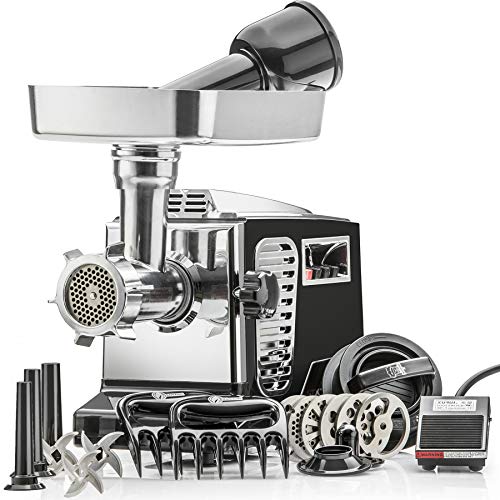
- No. 12 grinder with 220–260 lb./hour stated output
- Handles certain soft bones and includes a foot pedal
- Broad accessory package for sausage, kubbe, and burgers
Best For: High-volume grinding and versatile food preparation
Smart-Control Pick

- Touchscreen with three speed and reverse settings
- Auto-reverse helps reduce jams
- Built-in storage and up to 4 lb./minute output
Best For: Convenient everyday home grinding
Compact Value Pick

- Processes about 4–5 lb. of meat per minute
- Compact aluminum design for home use
- Includes sausage tubes and stainless steel grinding parts
Best For: Moderate household batches and sausage making
Powerhouse Pick
3000W Stainless Steel Meat Grinder

- Up to 5 lb/min claimed grinding speed
- Includes sausage, kubbe, and grinding accessories
- Reverse function and thermal protection
Best For: Home cooks making ground meat and sausages
Heavy-Duty Classic
Weston #12 Meat Grinder & Sausage Stuffer

- 750W, 1 HP motor with 4–5 lb/min claim
- Two speeds plus reverse function
- Die-cast aluminum body and metal gears
Best For: Grinding meat and stuffing sausages with durable hardware
Smart Control Pick
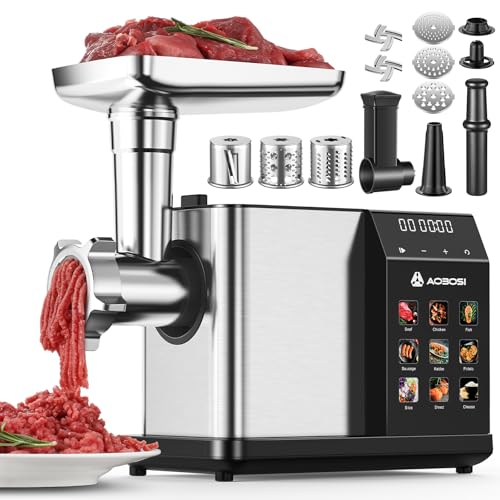
- Color touch screen with nine presets
- Nine speeds and automatic reverse
- Includes sausage, kubbe, and cutting attachments
Best For: Convenience-focused cooks wanting versatile controls
High-Volume Pick
VEVOR 1 HP Commercial Meat Grinder

- Processes up to 552 lbs/h
- Includes plates, kibbe kit, and sausage tubes
- Dishwasher-safe removable parts
Best For: High-volume home prep and light commercial use
Accessory-Rich Home Pick
STX Turboforce 3000 Electric Grinder

- Large hopper holds about 3 lbs
- Includes plates, blades, tubes, kubbe maker, and burger press
- Optional foot pedal and three-year warranty
Best For: Versatile home meat preparation
Compact Kitchen Pick
Aiheal Stainless Steel Meat Grinder

- Includes three plates and three sausage tubes
- Handles several common meats and recipes
- Features reverse operation and overload protection
Best For: Everyday home kitchen use
Heavy-Duty Home Pick – LEM BigBite #8
For shoppers comparing electric meat grinders, the LEM Products BigBite #8 is a durable home-kitchen option with a stainless steel build, 0.5 HP motor, and output of about 7 pounds per minute. It is designed for repeated grinding of meat for burgers, sausage, game, and pet food, but not bones.
Best For: Home cooks and hunters who want a sturdy grinder for small to medium batches and regular use.
Pros:
- Processes about 7 pounds of meat per minute.
- Stainless steel construction and noise-dampening design support durable, quieter operation.
- Includes three plates, a knife, stomper, and sausage-stuffing tubes.
- Backed by a five-year factory warranty and lifetime customer support.
Cons:
- Not designed for grinding bones.
- At 32.6 pounds, it is relatively heavy to move and store.
The BigBite #8 is a strong fit when long-term durability and dependable batch processing matter more than portability. Its generous warranty and replacement-parts support add reassurance for frequent users.
High-Capacity Versatility Pick – STX Turboforce II 4000
Among electric meat grinders, the STX International Turboforce II 4000 stands out for its large No. 12 grinding format, high-capacity tray, and extensive accessory package. Its motor is rated at 2000 maximum watts, with stated output of roughly 220 to 260 pounds per hour depending on the meat and plate used.
Best For: Users who need high-volume home grinding, soft-bone capability, and a broad selection of sausage and burger attachments.
Pros:
- Large feed system and high-capacity tray hold over 3 pounds of meat.
- Can handle soft bones such as chicken, rabbit, squirrel, and quail bones.
- Includes five grinding plates, three cutting blades, sausage tubes, kubbe attachment, foot pedal, meat claws, and patty press.
- Patented air-cooling system and circuit breaker are designed for demanding operation.
Cons:
- The extensive accessory set may be more than casual users need.
- The three-year guarantee has specific coverage and shipping terms.
This is the most capability-focused option in the group. Choose it if you regularly process large quantities or specifically want soft-bone grinding and hands-free foot-pedal control.
Smart-Control Pick – AAOBOSI 3000W Max
The AAOBOSI is a modern choice among electric meat grinders, combining a color touch screen, three speed settings, auto-reverse, and built-in accessory storage. Its stated output is up to 4 pounds per minute, making it suitable for home grinding, sausage preparation, and raw pet food.
Best For: Busy home cooks who value simple controls, jam prevention, organized storage, and quick cleanup.
Pros:
- Touchscreen controls offer Meat, Sausage, and Reverse settings.
- Auto-reverse function helps address clogging and jamming.
- Built-in storage keeps the included plates, blades, and attachments organized.
- Stated output reaches 4 pounds per minute, with dishwasher-safe plates and blades.
Cons:
- The manufacturer advises avoiding continuous use beyond 10 minutes to prevent overheating.
- Attachments are recommended to be hand-washed for best results despite dishwasher-safe plates and blades.
The AAOBOSI prioritizes convenience over extended continuous operation. Its controls, storage, and auto-reverse feature make it appealing for routine household batches, provided you follow the usage-time guidance.
Compact Value Pick – LEM MightyBite #8
The LEM Products MightyBite #8 is a compact electric meat grinder for home cooks who want straightforward grinding and sausage stuffing without stepping up to a heavier commercial-style machine. Its 500-watt motor processes about 4 to 5 pounds per minute and handles beef, pork, poultry, lamb, and venison.
Best For: Home users who need a relatively compact grinder for moderate batches, burgers, sausage, game, or pet food.
Pros:
- Processes approximately 4 to 5 pounds of meat per minute.
- Aluminum construction helps keep the grinder more compact than heavier stainless steel models.
- Includes stainless steel plates, knife, stomper, and three sausage-stuffing tubes.
- Permanently lubricated motor and circuit breaker support dependable operation.
Cons:
- Not intended for grinding bones.
- Its stated capacity and output are lower than the larger, high-volume option in this roundup.
- Covered by a two-year factory warranty, shorter than the BigBite model’s warranty.
The MightyBite #8 is a practical middle ground for ordinary household preparation. It offers useful sausage-making accessories and solid meat throughput while keeping the design simpler than high-capacity alternatives.
Powerhouse Pick – 3000W Stainless Steel Meat Grinder
For shoppers comparing electric meat grinders, this Sinyder model emphasizes fast home processing, durable construction, and sausage-making versatility. Its copper motor is rated at 700 watts with a claimed 3,000-watt maximum output, and it includes multiple grinding and stuffing accessories.
Best For: Home cooks who want a high-output grinder with sausage and kubbe attachments.
Pros:
- Grinds up to 5 pounds per minute according to the supplied specifications.
- Includes two stainless steel blades, two grinding plates, sausage tubes, and a kubbe kit.
- Reverse function, thermal protection, and a circuit breaker help support safer operation.
- Stainless steel housing and metal gears are designed for durability.
Cons:
- The manufacturer advises that the grinder, tray, and grinder head should not go in the dishwasher.
- Its 3-pound listed capacity may be limiting for especially large batches.
This is a feature-rich choice for everyday grinding and homemade sausages. The included storage case helps organize the attachments, while the one-button controls keep operation straightforward.
Heavy-Duty Classic – Weston #12 Meat Grinder & Sausage Stuffer
Among electric meat grinders, the Weston #12 stands out for its heavy-duty die-cast aluminum body, metal gears, and dedicated two-speed operation. Its 750-watt, 1-horsepower motor is designed for efficiently grinding a variety of meats while also supporting sausage stuffing.
Best For: Home users who prioritize a sturdy build and separate speeds for grinding and stuffing.
Pros:
- Processes approximately 4 to 5 pounds of meat per minute.
- Two speeds allow slower sausage stuffing and faster meat grinding.
- Reverse function helps address jams during use.
- Includes medium and coarse stainless steel plates plus sausage-making accessories.
Cons:
- At 13.5 pounds, it is substantially heavier than some home countertop grinders.
- The included accessory set is more focused than models that also offer vegetable-cutting attachments.
The Weston is a practical pick when durable construction and straightforward controls matter more than digital features. Its cam-action headlock is intended to make the grinding head quicker to secure and remove.
Smart Control Pick – AAOBOSI Digital Meat Grinder
This AAOBOSI model takes a more automated approach to electric meat grinders, pairing a color touch screen with nine presets and nine speed settings. It also adds auto-reverse, built-in accessory storage, and attachments for sausage, kubbe, vegetables, and cheese.
Best For: Home cooks who want preset controls and broad attachment versatility.
Pros:
- Color touch screen provides nine one-touch preset functions.
- Nine speed settings offer control over grinding and preparation tasks.
- Includes three grinding plates, two blades, sausage and kubbe attachments, and cutting accessories.
- Built-in storage keeps accessories organized inside the unit.
Cons:
- The supplied guidance recommends avoiding continuous use beyond 10 minutes to help prevent overheating.
- Although the plates and blades are listed as dishwasher-safe, the instructions also recommend hand-washing attachments after use.
- Its listed capacity is 3 pounds, despite the claimed output of up to 4 pounds per minute.
The AAOBOSI is a strong fit for shoppers who value convenience and recipe flexibility. Its digital interface and auto-reverse simplify operation, while the accessory storage helps keep a busy kitchen more organized.
High-Volume Pick – VEVOR 1 HP Commercial Meat Grinder
For shoppers comparing electric meat grinders for frequent meal prep or small commercial workloads, the VEVOR stands out with a stated capacity of up to 552 pounds per hour. Its metal construction, multiple plates, and sausage-making accessories make it a versatile option for prepared, unfrozen meat.
Best For: High-volume home prep, restaurants, butcher shops, and sausage-making workshops.
Pros:
- 750W/1 HP pure copper motor and three-stage auger are designed for high throughput.
- Includes two blades, 6mm and 8mm plates, a kibbe kit, and three sausage tubes.
- Removable parts are dishwasher-safe, while cooling and anti-vibration features support operation.
Cons:
- Not suitable for bones or frozen meat.
- The motor housing must be wiped clean rather than immersed or rinsed.
The VEVOR is the strongest fit here for buyers prioritizing stated grinding capacity and commercial-style construction. Its broad accessory set adds flexibility, provided your ingredients are properly prepared and unfrozen.
Accessory-Rich Home Pick – STX Turboforce 3000 Electric Grinder
The STX Turboforce 3000 is a feature-packed choice among electric meat grinders for home users who want several grinding and food-forming options. It includes a large hopper, multiple plates, sausage attachments, a kubbe maker, and an optional foot pedal.
Best For: Home cooks processing properly prepared meat for burgers, sausages, meatballs, and kubbe.
Pros:
- Large hopper holds approximately 3 pounds of prepared meat.
- Includes five grinding or stuffing plates, three blades, sausage tubes, kubbe attachment, and burger press.
- Offers optional foot-pedal operation and a three-year parts-and-labor warranty.
Cons:
- Intended for home use, not commercial applications.
- Should not be used with bones, tendons, vegetables, plants, nuts, or fruits.
- Available for 110V operation only.
This STX model makes sense when accessory variety matters more than commercial-duty capacity. Its stated 180-to-240-pound-per-hour output is substantial for home projects, but the ingredient restrictions require careful preparation.
Compact Kitchen Pick – Aiheal Stainless Steel Meat Grinder
For everyday kitchen use, this Aiheal model offers a straightforward way to compare electric meat grinders without a large accessory footprint. It includes three grinding plates, three sausage tubes, and reverse operation for unclogging, making it useful for common home recipes.
Best For: Home cooks making ground meat, sausages, kibbeh, burgers, and meat sauces.
Pros:
- Includes 2mm, 5mm, and 7mm plates plus three sausage-stuffer tubes.
- Supports beef, chicken, pork, venison, and fish preparation.
- Locking knob, overload protection, and a reverse button add practical operating features.
Cons:
- Removable parts are not dishwasher-safe and should be dried with a soft cloth.
- The supplied notes list a 300W motor with 3200W maximum locked power, so wattage claims should be interpreted carefully.
The Aiheal is a practical home-focused option for buyers who want basic grinding and sausage-stuffing versatility in a relatively compact unit. Its manual-cleaning requirement is the main tradeoff.
How We Picked the Best Electric Meat Grinders
We evaluated these models around the factors that matter most during real kitchen and home-processing use: motor capacity, grinding performance, included plates, sausage-stuffing accessories, controls, construction, footprint, and cleanup. Maximum wattage can be useful for comparing advertised power, but it does not tell the whole story. A grinder’s feed design, auger, blade quality, cooling, and ability to maintain a steady pace are equally important.
We also considered product type. Compact aluminum models may suit occasional home batches, while larger #8 and #12 grinders are better for frequent processing or larger quantities. Features such as foot pedals, multiple speeds, digital controls, and bone-grinding claims can be useful, but they should not outweigh safety, manufacturer guidance, or overall build quality.
Quick Comparison
| Best for | Look for | Typical advantage |
|---|---|---|
| Occasional home use | Compact #8 grinder, moderate wattage | Lower storage demands and easier handling |
| Sausage making | Multiple tubes, stuffing plate, or dedicated stuffer accessories | More flexibility for different casings |
| Large batches | #12 head, stronger motor, high feed capacity | Faster processing and fewer pauses |
| Hands-free control | Foot pedal or clearly placed controls | Better workflow while feeding meat |
| Texture experimentation | Several grinding plates and speeds | More control over coarse, medium, and fine results |
Key Buying Factors for Electric Meat Grinders
Motor and Real-World Capacity
Choose based on how much meat you process per session, not just the advertised peak wattage. A larger motor and throat can help with sustained batches, but capacity ratings vary by manufacturer and depend on meat temperature, trimming, and preparation. Keep meat very cold and cut it into manageable pieces for smoother feeding.
Plate Sizes, Blades, and Attachments
Multiple plates let you change texture for burgers, meatballs, fillings, and sausage. Check whether replacement plates and blades are readily available. If sausage is a priority, confirm the included stuffing tubes and understand that a grinder attachment may work more slowly than a dedicated sausage stuffer.
Construction, Controls, and Cleanup
Metal components can improve durability, while lighter housings are easier to move and store. Reverse functions help clear minor jams. Digital controls and foot pedals may improve convenience, but simple switches can be easier to operate and maintain. Removable parts should be easy to wash and dry thoroughly; never assume every component is dishwasher-safe without checking the manual.
Safety and Operating Limits
Look for a stable base, a food pusher, overload protection, and clear instructions. Do not grind bones unless the manufacturer explicitly permits it for that model, and follow all limits for bone size, meat preparation, and operating time.
Who Should Buy Which Electric Meat Grinders?
Choose a compact #8 machine if you process modest quantities, have limited counter space, or want a practical entry point for burgers and occasional sausage. A higher-capacity #8 model is a better middle ground for families that process meat regularly. Select a #12 grinder when you routinely handle large batches and value throughput over portability.
Buy a model with several plates and sausage tubes if you want one appliance for varied recipes. A foot pedal or multiple-speed control is worthwhile for users who prioritize workflow and texture control. Finally, compare warranty coverage, replacement-part availability, storage requirements, and cleaning effort before choosing based on headline wattage alone.