Making tomato sauce from a large harvest is much easier with the right electric tomato press. These machines separate skins and seeds while producing smooth pulp for sauces, purées, salsa, and preserves.
We’ve selected 10 models ranging from compact home-friendly strainers to higher-capacity stainless steel machines. Use the guide below to compare output, construction, cleanup, and the features that matter most for your kitchen or processing setup.
Best 10 Electric Tomato Presses Picks for 2026
Versatile Home Preserving
Johnny Apple Sauce Maker with Electric Motor

- Electric motor or hand-crank operation
- Four screens for sauces, purees, and salsa
- Five-year warranty and sturdy clamp mount
Best For: Multi-purpose small-batch preserving
High-Volume Italian Performance
Reber N.3 Electric Tomato Strainer

- 450W induction motor for continuous operation
- Rated for up to 309 pounds per hour
- Durable cast iron and stainless steel construction
Best For: Large harvests and extended processing sessions
Compact Italian Masticating Design
OMRA Spremy Electric Tomato Strainer Model 850

- 110 RPM masticating-style auger
- Processes fresh or cooked tomatoes
- Compact die-cast metal design
Best For: Compact tomato puree processing
Easy Batch Sauces
Weston Deluxe Electric Tomato Strainer

- One-gallon hopper for batch processing
- Two-speed motor with reverse function
- Three stainless steel screens included
Best For: Home canning, salsa, and garden harvests
High-Capacity Pick
COSTWAY 450W Electric Tomato Strainer
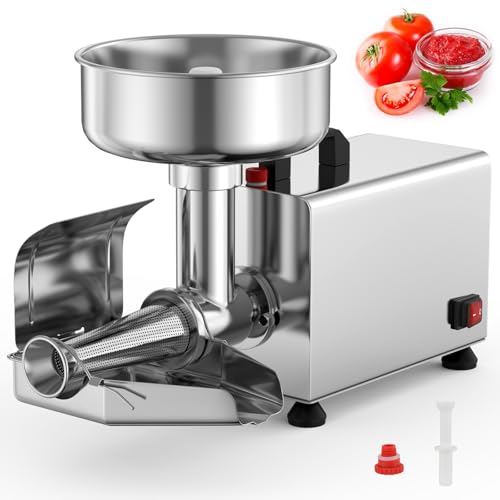
- Advertised 200–350 lb/h processing capacity
- Large 8.5-inch chute and 450W motor
- 304 stainless steel with tool-free disassembly
Best For: High-volume sauce and preserve making
Flexible Budget Pick
Johnny Apple Sauce Maker Model 250

- Manual crank with optional electric motor
- Includes 1.3mm apple/tomato screen
- Secure clamp fits 3/4–2-1/8-inch counters
Best For: Flexible, compact sauce making with upgrade potential
Commercial-Style Midrange Pick
450W Stainless Steel Tomato Mill

- Advertised output of about 110 lb/h
- 8.4-inch funnel and 304 stainless-steel body
- Disassembles for cleaning with adjustable bowl angle
Best For: Regular medium-volume home or small commercial batches
High-Volume Harvest Pick
VEVOR 370W Electric Tomato Strainer

- Separates peels and seeds in one pass
- Large hopper supports batch processing
- Stainless components disassemble for cleaning
Best For: Bulk sauce making, puree, and canning
Commercial-Style Sauce Maker

- 304 stainless food-contact parts
- 9-inch funnel supports steady feeding
- Adjustable trough helps control discharge
Best For: Sauces, ketchup, and fruit jams
Most Versatile Kitchen Option
AIRMSEN Meat Grinder and Tomato Press

- Handles tomatoes, meat, sausage, and kibbeh
- Includes three grinding plate sizes
- Reverse function helps clear jams
Best For: Multifunction home kitchen preparation
Versatile Home Preserving – Johnny Apple Sauce Maker with Electric Motor
If you want electric tomato presses that can handle more than sauce, this Johnny Apple Sauce Maker is a flexible option for home preserving. Its included motor replaces the hand crank, while multiple screens let you adjust the texture for sauces, purees, juices, jams, and salsa.
Best For: Home cooks who want one strainer for tomatoes, fruit, vegetables, and specialty purees.
Pros:
- Includes an electric motor plus a hand-crank option.
- Comes with berry, apple/tomato, pumpkin, and salsa screens.
- Separates skins and seeds from produce for smoother sauces.
- Cast aluminum body, stainless steel screens, BPA-free plastic parts, and a five-year warranty.
Cons:
- Clamp mounting requires a countertop between 3/4 and 2-1/8 inches thick.
- The clamp-based design may require setup before each use.
This is a strong all-purpose choice if versatility matters more than a dedicated high-volume machine. The included accessories make it useful for a broad range of small-batch kitchen projects.
High-Volume Italian Performance – Reber N.3 Electric Tomato Strainer
For shoppers comparing electric tomato presses for serious preserving, the Reber N.3 emphasizes continuous operation and durable construction. Its 450W induction motor is rated for processing up to 309 pounds of tomatoes per hour, making it suited to large harvests and batch cooking.
Best For: Large-batch tomato processing and cooks who value Italian construction and long-running operation.
Pros:
- 450W induction motor supports continuous use and high throughput.
- Processes tomatoes, jams, and fruit juices.
- Cast iron body, stainless steel components, and a temperature-resistant acetal resin auger.
- Long Life oil-bath gearbox is designed for durable, maintenance-free operation.
Cons:
- At 21 pounds, it is heavier than more compact options.
- Optional attachments are required for functions such as grinding or pasta pressing.
- Hand-wash care is specified.
The Reber N.3 stands out when capacity and robust materials are priorities. It is likely more machine than occasional users need, but its continuous motor and heavy-duty build fit demanding preserving sessions.
Compact Italian Masticating Design – OMRA Spremy Electric Tomato Strainer Model 850
The OMRA Spremy Model 850 is one of the more compact electric tomato presses for separating puree from skins and seeds. Its 1/4 HP motor turns a food-grade nylon auger at 110 RPM, using a masticating-style process for fresh or cooked tomatoes.
Best For: Users seeking a compact Italian-made strainer for tomato puree and apple processing.
Pros:
- Automatically separates tomato puree from skins and seeds.
- Handles fresh or cooked tomatoes.
- Compact listed dimensions of 7.87 inches by 7.87 inches by 7.87 inches.
- Die-cast metal housing, stainless steel hopper, and cooling-fan-equipped motor.
Cons:
- The listed power specification is 220 volts, so electrical compatibility should be confirmed.
- Its 225W motor is less powerful than the 450W Reber model.
- The supplied notes identify tomato and apple use but do not list multiple included screens.
This model appeals to shoppers who want a small-footprint strainer with a slow auger design and Italian manufacture. Check the voltage carefully before buying, especially for use in a standard household setup.
Easy Batch Sauces – Weston Deluxe Electric Tomato Strainer
The Weston Deluxe is a practical pick among electric tomato presses for home canning and preserving. Its 250W, two-speed motor, one-gallon hopper, reverse function, and three stainless steel screens make it suited to tomatoes, soft produce, purees, jellies, and salsa.
Best For: Home gardeners and preservers processing moderate-to-large batches with adjustable textures.
Pros:
- One-gallon hopper accommodates larger batches.
- Forward and reverse motor speeds help with processing and jam prevention.
- Includes 1.5mm, 3mm, and 6mm stainless steel screens.
- Stomper supports safer feeding into the hopper.
Cons:
- One-year manufacturer warranty is shorter than some competing options.
- Its 17-inch height may require dedicated counter or storage space.
- The 250W motor is less powerful than high-capacity commercial-style models.
With a generous hopper and useful screen selection, the Weston is a balanced choice for household preserving. The reverse setting and included stomper add practical convenience when processing batches of garden produce.
High-Capacity Pick – COSTWAY 450W Electric Tomato Strainer
For shoppers comparing electric tomato presses, the COSTWAY stands out for its advertised high throughput and large 8.5-inch feed chute. Its 450W copper motor, stainless-steel construction, and tool-free disassembly make it suited to substantial sauce and preserve-making tasks.
Best For: High-volume home preserving or small commercial-style batches of tomato sauce, jams, and fruit purees.
Pros:
- Advertised capacity of 200–350 pounds of sauce per hour.
- Large feed chute and included safety pusher simplify feeding.
- Food-grade 304 stainless steel with detachable, dishwasher-safe parts.
- Enclosed motor guard, waterproof insulated switch, and anti-slip feet support safer operation.
Cons:
- At 22 pounds, it is relatively heavy and substantial for storage.
- The notes specify hand washing in the product-care details, despite dishwasher-safe detachable parts being advertised.
The COSTWAY is the most production-oriented option here, particularly if speed and batch size matter. Its larger footprint and heavier build make it better suited to a dedicated work area than occasional countertop use.
Flexible Budget Pick – Johnny Apple Sauce Maker Model 250
Although the Johnny Apple Sauce Maker is supplied as a hand-crank unit, it is a flexible alternative for shoppers considering electric tomato presses because it can accept an optional electric motor. The clamp-mounted design separates skins and seeds while supporting sauces, purees, jams, juices, and other preparations.
Best For: Buyers who want a compact manual strainer now with the option to add electric operation later.
Pros:
- Handles tomatoes, apples, berries, vegetables, sauces, baby foods, and more.
- Includes an apple/tomato screen with 1.3mm holes and a standard spiral.
- Clamp fits countertops from 3/4 to 2-1/8 inches thick.
- Light 4.3-pound design and a stated five-year warranty.
Cons:
- Electric operation requires the optional VKPMOTOR, sold separately.
- Its 4.3-pound aluminum-and-plastic construction is less suited to high-volume electric processing than dedicated motorized models.
The Model 250 is a practical choice if you value versatility, portability, and a lower-commitment setup. Factor in the separate motor cost if hands-free or electric processing is essential.
Commercial-Style Midrange Pick – 450W Stainless Steel Tomato Mill
This 450W stainless-steel tomato mill is a straightforward option among electric tomato presses, with an 8.4-inch funnel and an advertised output of about 110 pounds of sauce per hour. Its disassemblable design, adjustable bowl angle, and heat-dissipating ventilation are useful for repeated sauce and jam preparation.
Best For: Home preservers and small food-service users seeking a powered stainless-steel mill for regular medium-volume batches.
Pros:
- Pure copper 450W motor produces approximately 110 pounds of sauce per hour.
- 304 food-grade stainless-steel body is described as durable and rust-resistant.
- Large 8.4-inch funnel helps load more fruit at once.
- Fully disassemblable construction and adjustable bowl support cleanup and drainage.
Cons:
- At about 9.5 kilograms, it is not especially lightweight.
- The supplied notes do not specify included spare screens or multiple mesh options.
This tomato mill offers a useful middle ground between manual equipment and the highest-capacity machine in this group. Its advertised output and stainless-steel build make it appealing for regular batches, while its size favors a dedicated storage spot.
High-Volume Harvest Pick – VEVOR 370W Electric Tomato Strainer
For shoppers comparing electric tomato presses, the VEVOR 370W tomato strainer is designed for efficient batch processing. Its large hopper, stainless-steel components, and claimed capacity of up to 200 pounds per hour make it a practical option for sauce, puree, juice, jam, and canning projects.
Best For: Home preservers and harvest-season cooks processing large quantities of tomatoes.
Pros:
- Separates peels and seeds while producing sauce, puree, or juice in one pass.
- Large hopper and 370W motor support high-volume processing.
- Stainless-steel hopper, screen, tray, and guard are suited to frequent use.
- Core components disassemble without tools for quicker cleanup.
Cons:
- Weighs 21.7 pounds, so it is not especially lightweight.
- Tomatoes should be cut into small pieces to help reduce clogging.
Choose this VEVOR model when throughput and easier cleanup matter more than compact storage. It is especially well matched to bulk sauce making and canning.
Commercial-Style Sauce Maker – VBENLEM 370W Tomato Strainer
Among electric tomato presses, the VBENLEM 370W model emphasizes durable food-contact construction and convenient feeding. It has a 9-inch funnel, an adjustable discharge trough, and a pure copper motor for processing tomatoes and making sauces or jams.
Best For: Cooks who want a stainless-oriented machine for tomato sauce and fruit-jam preparation.
Pros:
- Food-contact parts are made from 304 stainless steel.
- 370W pure copper motor is housed in a stainless-steel outer casing.
- Wide 9-inch funnel helps with feeding fruit.
- Adjustable trough and brace help direct sauce and reduce splashing.
Cons:
- At 22 pounds, it is a substantial countertop appliance.
- Its listed capacity and performance specifications may be more than needed for occasional small batches.
The VBENLEM is a sensible choice for shoppers prioritizing sturdy food-contact materials and controlled sauce discharge. Its low-noise and easy-cleaning features add convenience during repeated processing.
Most Versatile Kitchen Option – AIRMSEN Meat Grinder and Tomato Press
If you want electric tomato presses with added kitchen utility, the AIRMSEN combines tomato straining with meat grinding, sausage making, and kibbeh preparation. Its included tomato strainer kit and three grinding plates make it a multifunctional choice for everyday home cooking.
Best For: Home cooks who want one compact appliance for tomato sauce and several meat-preparation tasks.
Pros:
- Combines tomato pressing, meat grinding, sausage making, and kibbeh preparation.
- Includes 5 mm, 7 mm, and 12 mm grinding plates.
- Reverse function helps clear jams, while rubber feet improve stability.
- Detachable parts make hand cleaning straightforward.
Cons:
- Not dishwasher safe; hand washing is recommended.
- Its tomato-pressing capacity is not specified in the supplied details.
- Multifunction design may be unnecessary if tomato processing is the only goal.
The AIRMSEN stands out for versatility rather than tomato-only specialization. It makes the most sense for kitchens that will regularly use its grinder, sausage, kibbeh, and tomato-sauce functions.
How We Picked the Best Electric Tomato Presses
We focused on the features that have the greatest effect on real-world sauce making: motor power, stated processing capacity, hopper and chute design, materials, stability, cleaning requirements, and overall versatility. The selection includes clamp-based food strainers for occasional home use, electric mills for regular garden harvests, and commercial-style machines for larger batches.
Because advertised throughput can vary with tomato variety, ripeness, preparation, and operator technique, capacity figures should be treated as benchmarks rather than guarantees. A powerful motor is useful, but it does not replace a well-designed auger, durable screen, and easy pulp adjustment.
Quick Comparison of These Electric Tomato Presses
| Best For | What to Look For |
|---|---|
| Occasional home batches | Compact design, clamp or stable base, simple assembly, and easy cleanup |
| Garden harvests | Higher wattage, larger hopper, continuous-feed operation, and durable screens |
| Frequent preserving | Stainless-steel food-contact parts, replaceable components, and reliable cooling |
| High-volume processing | Commercial-grade construction, high stated output, and a strong, stable frame |
Key Buying Factors for Electric Tomato Presses
Motor Power and Throughput
Motors in this roundup range from roughly 370W to 450W, with some units using fractional-horsepower ratings. More power can help maintain steady operation when processing dense or large batches, but check the manufacturer’s capacity claims and duty-cycle guidance before buying.
Materials and Durability
Stainless-steel components are generally preferable for wet, acidic foods and frequent use. Also inspect the auger, screen, hopper, clamps, and frame. A sturdy machine is less likely to vibrate, walk across the counter, or require constant repositioning.
Screen Design and Pulp Control
The screen determines how effectively the machine separates skins and seeds. Adjustable pulp settings are valuable when you want thicker sauce, smoother purée, or more efficient extraction. Confirm whether extra screens or replacement parts are available.
Cleaning and Storage
Tomato pulp dries quickly, so removable food-contact parts make a major difference. Look for straightforward disassembly, dishwasher-safe components where approved, and a design without difficult-to-reach crevices. Measure your storage space before choosing a larger commercial-style unit.
Stability, Noise, and Safety
Clamp-based models need a compatible, solid work surface, while freestanding machines should have a broad base or nonslip feet. Consider noise if you will process indoors, and verify that guards, switches, and electrical specifications suit your kitchen setup.
Who Should Buy Which Electric Tomato Presses?
Choose a compact clamp-based strainer if you make sauce occasionally, have limited storage, or want a straightforward appliance for small batches. These models can be practical, but they depend more on proper counter installation.
Choose a midrange electric mill if you process garden tomatoes several times each season. A 370W–450W machine with a durable screen and removable parts offers a useful balance of speed, capacity, and convenience.
Choose a commercial-grade stainless-steel press if you preserve large harvests, operate a farm stand, or regularly make sauce in bulk. Higher-capacity machines cost more and take up more room, but they can reduce processing time and withstand heavier workloads.
Before ordering, confirm the voltage, included accessories, replacement-part availability, warranty, and manufacturer’s cleaning instructions. The best electric tomato press is the one whose capacity matches your normal batch size without creating unnecessary setup or maintenance work.