Making smooth tomato sauce at home does not require a large kitchen or commercial equipment. The right tomato press can separate skins and seeds efficiently while taking up minimal storage space.
These 10 options cover compact manual strainers, food mills, and electric machines, so you can choose a model that matches your batch size, counter space, and cleanup preferences.
Best 10 Tomato Presses for Small Kitchens Picks for 2026
Best Clamp-Mount Pick

- Secure clamp fits 3/4- to 2-1/8-inch countertops
- Includes tomato screen and standard spiral
- Handles sauces, purees, juices, and more
Best For: Small kitchens needing a versatile clamp-mounted strainer
Best Larger-Capacity Option
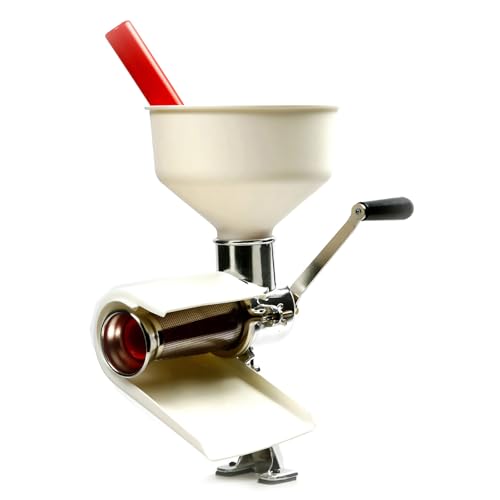
- Holds up to 3 quarts or 95 ounces
- Separates juice and pulp in one operation
- Includes fine mesh screen and standard spiral
Best For: Larger batches when storage space is available
Best Compact Tomato Specialist

- No peeling, coring, or deseeding required
- Suction-cup base helps secure placement
- Designed for juice, puree, sauce, and salsa
Best For: Quick, focused tomato preparation in tight spaces
Best Manual Puree Mill

- Three discs provide fine, medium, and coarse textures
- Non-slip legs fit pots and bowls up to 11 inches
- Foldable legs support compact storage
Best For: Adjustable purees and sauces in a space-conscious kitchen
Best Electric Batch Press

- 250-watt motor with forward and reverse speeds
- Three stainless steel screens for varied textures
- One-gallon hopper for larger preserving batches
Best For: Electric sauce making and garden-harvest processing
Best Compact Manual Option
Stainless Steel Rotary Food Mill

- Manual design needs no electricity
- Three milling discs support different textures
- Dual hooks and silicone grips improve stability
Best For: Small batches of sauce, puree, jam, and soft foods
Best Multi-Function Machine

- Presses tomatoes while grinding meat and making sausage
- Includes three cutting plates and tomato strainer kit
- Reverse function, safety lock, and non-slip feet
Best For: Small kitchens needing one appliance for multiple food tasks
Compact Kitchen Favorite

- Three discs for sauces, potatoes, jams, and more
- Dual-hook base and non-slip crank improve stability
- Dishwasher-safe design with hanging storage hole
Best For: Small kitchens needing a versatile manual tomato mill
Space-Saving Manual Pick

- Clamp-on base helps stabilize the mill at the counter edge
- Filter separates skins from juice and pulp
- Funnel supports steady feeding of tomato chunks
Best For: Small kitchens and occasional homemade sauces
High-Volume Power Option
VBENLEM Electric Tomato Strainer

- 370W motor for powered tomato and sauce processing
- 304 stainless steel food-contact parts
- Nine-inch funnel and adjustable discharge trough
Best For: High-volume preserving where counter space is available
Best Clamp-Mount Pick – Johnny Apple Sauce Maker
For small kitchens, the Johnny Apple Sauce Maker is a practical choice when you want a tomato press that clamps securely to a countertop instead of taking up permanent counter space. Its hand-crank design separates skins and seeds while producing sauces, purees, juices, and more.
Best For: Small kitchens needing a versatile, clamp-mounted tomato and produce strainer.
Pros:
- Clamp fits countertops from 3/4 to 2-1/8 inches thick.
- Includes an apple/tomato screen with 1.3 mm holes and a standard spiral.
- Can also handle purees, juices, jams, soups, baby foods, and sauces.
- Optional electric motor and additional screens are available separately.
Cons:
- The electric motor and extra screens cost extra.
- Its clamp-based setup requires a suitable countertop edge.
This is one of the more adaptable tomato presses for small kitchens, especially if secure mounting and multi-use functionality matter. Its included screen makes it ready for tomato sauce, while the removable hand crank helps keep the design straightforward.
Best Larger-Capacity Option – Norpro 1951 Sauce Master
The Norpro 1951 Sauce Master suits cooks who want a tomato press for small kitchens but still need a relatively generous 3-quart capacity. It forces produce through a chrome-plated steel screen, separating juice and pulp in one operation.
Best For: Making larger batches of tomato sauce, vegetable purees, and fruit preparations.
Pros:
- Offers a 3-quart, or 95-ounce, capacity.
- Automatically separates juice and pulp as food passes through the screen.
- Includes a fine mesh screen, standard spiral, recipe, and instruction booklet.
- Additional berry, pumpkin, and salsa screens are available separately.
Cons:
- Its listed dimensions are relatively large for a small kitchen.
- Specialty screens require separate purchases.
The Sauce Master is worth considering when batch capacity matters more than the smallest footprint. Measure your storage and work area first, since its listed dimensions are 16 by 15.5 by 20 inches.
Best Compact Tomato Specialist – Tomato Strainer
This compact tomato strainer is designed specifically for straightforward tomato prep, making it a convenient option among tomato presses for small kitchens. It ejects skins and seeds to the side while juice runs into the tray, with no peeling, coring, or deseeding required beforehand.
Best For: Fresh tomato juice, homemade sauces, salsa, and simple seasonal processing.
Pros:
- Processes tomatoes without peeling, deseeding, or coring first.
- Suction-cup base helps hold the strainer in place.
- Includes a stainless steel pusher for guiding tomatoes into the juicing area.
- Can strain, juice, and puree tomatoes for sauces and salsa.
Cons:
- Its plastic construction may feel less substantial than metal alternatives.
- The suction mount requires a suitable smooth surface for secure placement.
With its 9-by-6-by-8-inch listed dimensions and tomato-focused design, this model is a sensible fit when counter and storage space are limited. It is less of an all-purpose produce mill, but its focused workflow keeps tomato preparation simple.
Best Manual Puree Mill – OXO Good Grips Food Mill
The OXO Good Grips Food Mill is a useful alternative for small kitchens where compact storage and texture control are priorities. Rather than using a tomato-specific screen, it offers three grinding discs for fine, medium, and coarse purees and sauces.
Best For: Cooks who want adjustable puree textures and a mill that stores compactly.
Pros:
- Includes fine, medium, and coarse stainless steel grinding discs.
- Stainless steel bowl is suitable for hot foods and resists staining.
- Three non-slip legs fit bowls and pots up to 11 inches in diameter.
- Foldable legs aid storage, and the mill is listed as dishwasher safe.
Cons:
- It is a general food mill rather than a dedicated skin-and-seed tomato press.
- It does not provide the same automatic side ejection workflow described for tomato strainers.
Choose this OXO model if you value versatile textures and easy storage over dedicated tomato processing. Its approximately 2.3-quart capacity and foldable legs make it practical for small kitchens, while the three discs broaden its use for purees and sauces.
Best Electric Batch Press – Weston Deluxe Tomato Strainer
For shoppers comparing tomato presses for small kitchens, the Weston Deluxe Electric Tomato Strainer offers powered straining with a 250-watt motor, reverse mode, and three interchangeable stainless steel screens. Its 1-gallon hopper suits larger preserving sessions, though its 14-by-12-by-17-inch footprint is worth measuring before purchase.
Best For: Home cooks who want an electric tomato press for sauces, purees, jams, salsa, and batch preserving.
Pros:
- Separates tomato skins and seeds without coring.
- Includes 1.5mm, 3mm, and 6mm stainless steel screens for different textures.
- Two-speed 250-watt motor includes reverse operation to help clear jams.
- Large 1-gallon hopper supports bigger batches.
Cons:
- The larger hopper and 17-inch height may take substantial counter or storage space.
- Electric operation requires access to a 120-volt outlet.
This is the most capable option here for processing a garden harvest, but small-kitchen users should account for its size and storage needs. The multiple screens add useful flexibility for smooth or chunky preparations.
Best Compact Manual Option – Stainless Steel Rotary Food Mill
This manual rotary food mill is a practical choice among tomato presses for small kitchens because it needs no outlet and stores more simply than an electric machine. Its stainless steel body, dual hooks, silicone-covered handles, and three milling discs support hands-on sauce and puree preparation.
Best For: Cooks who want a compact, manually operated tool for tomato sauce, jams, mashed potatoes, and fruit or vegetable purees.
Pros:
- Stainless steel construction is sturdy and can also function as a colander or vegetable steamer.
- Dual hooks help secure the mill over a bowl.
- Three milling discs provide different straining textures.
- Silicone-covered handles and crank improve grip and comfort.
Cons:
- Manual cranking requires more effort than an electric press.
- The supplied notes do not specify the bowl capacity or exact disc hole sizes.
With a 1.32-kilogram weight and no motor, this mill fits cooks who value control and straightforward storage over speed. It is a versatile small-kitchen pick for modest batches and several types of soft foods.
Best Multi-Function Machine – AIRMSEN Electric Sauce Press
The AIRMSEN combines tomato pressing with meat grinding, sausage making, and kibbeh preparation, making it a space-saving alternative for cooks who need several functions from one appliance. Its compact-design listing measures 12.6 by 6.3 by 12.6 inches, but cleaning requires hand washing rather than a dishwasher.
Best For: Home cooks who want one electric appliance for tomato sauce plus meat grinding and sausage or kibbeh preparation.
Pros:
- Combines tomato straining, meat grinding, sausage making, and kibbeh preparation.
- Includes three cutting plates in 5mm, 7mm, and 12mm sizes.
- Reverse function helps clear stuck ingredients.
- Non-slip feet and a safety-lock knob support stable operation.
Cons:
- Parts are not dishwasher safe and hand washing is recommended.
- Its broader meat-grinder functionality may be unnecessary if tomato pressing is the only goal.
- The supplied details list both a 2500-watt peak motor claim and 300-watt wattage specification, so power comparisons require care.
This machine makes sense when cabinet space is limited but multiple food-preparation functions matter. For tomato-only use, its extra attachments may add complexity, while its hand-wash requirement is an important maintenance consideration.
Compact Kitchen Favorite – Stainless Steel Food Mill
For tomato presses for small kitchens, this stainless steel food mill offers a space-conscious manual option for sauces, mashed potatoes, jams, and canning. Its three milling discs and hanging hole add flexibility without relying on electricity.
Best For: Home cooks who want one compact manual mill for tomato sauce and other soft foods.
Pros:
- Stainless steel construction with a mirror-polished finish.
- Three interchangeable discs handle different textures and can help remove seeds.
- Dual hooks and a soft, non-slip crank support steadier bowl use.
- Dishwasher-safe parts and a hanging hole simplify cleanup and storage.
Cons:
- Manual cranking requires more effort than an electric strainer.
- Its 1.29 kg weight may feel substantial for a small hand tool.
This is a practical choice when storage space matters and you also want a versatile tool for potatoes, fruit, vegetables, and tomato preparations. The included spoon, funnel, and measuring spoon add convenience for occasional batch cooking.
Space-Saving Manual Pick – Clamp-On Tomato Grinder
This clamp-on grinder is a useful choice among tomato presses for small kitchens because it attaches to a countertop edge instead of occupying a broad footprint. The hand crank separates skins from the flowing pulp for sauces, juices, soups, jams, and pie fillings.
Best For: Small-space cooks processing modest amounts of tomatoes and other soft produce by hand.
Pros:
- Tabletop clamp helps keep the processor firm and reduces wobbling.
- Filter blocks tomato skins while pulp flows into a bowl.
- Funnel-shaped opening accepts tomato chunks for steady feeding.
- Removable design can be stored after use to free counter space.
Cons:
- Manual operation may be tiring during extended processing.
- The supplied notes do not specify dishwasher-safe parts or included accessories.
With a 3.94-by-6.3-by-9.06-inch footprint and clamp-based setup, this model suits kitchens where permanent counter space is limited. It is geared toward straightforward home prep rather than high-volume processing.
High-Volume Power Option – VBENLEM Electric Tomato Strainer
Although larger than typical tomato presses for small kitchens, this electric strainer is worth considering when frequent batches matter more than compact storage. Its 370W motor, stainless steel food-contact parts, and wide funnel are designed for sauce and jam processing.
Best For: Serious home preservers or small food operations that need powered, higher-volume tomato processing.
Pros:
- 370W pure copper motor provides powered processing.
- Food-contact components use 304 stainless steel and the unit is easy to disassemble.
- Nine-inch funnel supports feeding larger quantities of fruit.
- Adjustable trough, low-noise operation, and waterproof level II construction add practical convenience.
Cons:
- At 22 pounds and 19.3 inches long, it is not especially compact.
- It requires a 110V electrical connection.
- Its capacity and commercial-grade design may be excessive for occasional small batches.
This is the performance-focused option of the group, with a stated processing capacity of 90–160 kg per hour and applications including ketchup and fruit sauces. Check available counter and storage space before choosing it for a small kitchen.
How We Picked the Best Tomato Presses for Small Kitchens
We focused on the features that matter most when space, storage, and cleanup are limited: overall footprint, operating method, stability, strainer design, capacity, and ease of disassembly. The lineup includes clamp-based presses, rotary food mills, electric tomato strainers, and multifunction machines.
We also considered whether each design is suited to occasional fresh sauce, larger preserving projects, or other tasks such as pureeing vegetables, making jam, or processing soft foods. Product descriptions and specifications should be checked carefully before purchase, especially for motor capacity, included screens, and dishwasher compatibility.
Quick Comparison
| Type | Best For | Main Advantage | Potential Trade-Off |
|---|---|---|---|
| Manual clamp press | Small batches and limited storage | Compact, simple, and usually affordable | Requires hand cranking |
| Rotary food mill | Sauces, purees, and mashed foods | Versatile with interchangeable discs | May not separate seeds as completely as a dedicated press |
| Electric tomato strainer | Frequent processing or larger batches | Faster with less manual effort | Needs counter space, power, and more cleanup |
| Multifunction electric machine | Users who want several food-processing functions | Combines grinding and straining capabilities | Often bulkier than a dedicated mill |
Key Buying Factors for Tomato Presses for Small Kitchens
Size and Storage
Measure both your counter and cabinet space. A clamp-style model or compact food mill is easier to store than a commercial-style electric machine. Also check whether the hopper, handle, and screen detach for storage.
Manual or Electric Operation
Manual presses are quiet, inexpensive, and convenient for occasional batches. Electric models are more practical when processing garden tomatoes or making sauce for canning, but they require an outlet and a stable setup.
Strainer and Pulp Control
Look for replaceable or included screens suited to tomatoes. A well-designed screen should separate skins and seeds while allowing useful pulp to pass through. Adjustable pulp settings can help tailor sauce texture.
Stability and Cleanup
Strong clamps, nonslip feet, and a rigid frame reduce movement during use. Removable parts simplify rinsing, while stainless steel components generally offer better durability and odor resistance than lower-grade materials.
Batch Size and Versatility
Choose a small manual mill for fresh dinner portions and a higher-capacity electric press for preserving. If you also make mashed potatoes, baby food, or fruit puree, a food mill with multiple discs may provide better value.
Who Should Buy Which Tomato Presses for Small Kitchens?
Choose a clamp-based manual press if you have limited storage, make modest batches, and want a straightforward tool. Choose a rotary food mill if versatility matters more than maximum throughput and you want one device for sauces, purees, and soft foods.
Choose an electric tomato strainer if you regularly process large quantities or want to reduce hand cranking. Choose a multifunction electric model if grinding meat and other food-preparation tasks are also important. For most small kitchens, prioritize a compact footprint, easy cleaning, secure stability, and a capacity that matches your normal batch size rather than buying the most powerful machine available.