Choosing among oil presses for small businesses means balancing throughput, seed versatility, temperature control, and the space available in your workspace. The right machine should match your expected production volume without creating unnecessary cleanup or maintenance.
This roundup compares 10 electric hot- and cold-press models across different power levels and capacities, helping you narrow the list according to your business needs and budget.
Best 10 Oil Presses for Small Businesses Picks for 2026
Best All-Around Starter

- Hot and cold pressing with 122–572°F control
- Supports 30+ nuts and seeds
- Includes filter, cup, gloves, and brush
Best For: Small shops, restaurants, and market sellers
Best Dual-Head Productivity

- Presses two ingredients simultaneously
- Supports 24-hour continuous operation
- Includes two hoppers, cups, and strainers
Best For: Small producers needing parallel processing
Best High-Volume Commercial Pick
20–30 kg/h Automatic Oil Press

- 23-liter hopper for larger batches
- 20–30 kg/h stated pressing speed
- Hot and cold modes with digital controls
Best For: Commercial producers processing larger batches
Best Compact Dual-Outlet Option
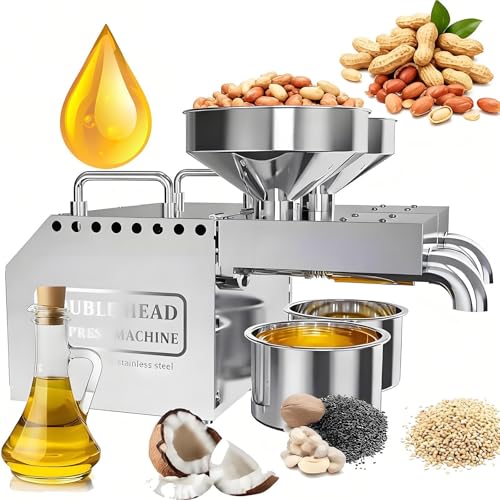
- Dual outlets and independent operation
- 360-second stated preheating time
- Hot and cold pressing for 30+ ingredients
Best For: Countertop operations with moderate throughput
Versatile Commercial Press

- Hot- and cold-press modes
- Temperature display and adjustment
- Claimed capacity up to 13.5 lb/hour
Best For: Small businesses processing common nuts and seeds
High-Capacity Dual Press
1500W Double-Outlet Oil Expeller

- Two independent motors and outlets
- Designed for continuous operation
- Noise rating below 70 dB
Best For: Small commercial operations needing parallel pressing
Temperature-Controlled Press
610W Automatic Hot and Cold Extractor

- Hot- and cold-press capability
- Digital temperature control
- Overheat protection and auto shutoff
Best For: Small businesses wanting controlled, repeatable pressing
High-Capacity Pick

- 1800W brushless copper motor
- Hot and cold pressing up to 572°F
- Stainless steel with cooling features
Best For: Restaurants and food markets needing a high-power press
Controlled-Temperature Pick
Automatic Stainless Steel Oil Press

- 50–250°C adjustable temperature
- Automatic heating with temperature display
- Stated 3–6 kg-per-hour processing range
Best For: Small producers wanting guided, repeatable operation
Precision Workflow Pick
Digital Cold and Hot Oil Press

- Digital temperature display and timer
- Processes 6.61–13.22 pounds per hour
- Cold and hot modes with detachable parts
Best For: Small operators needing temperature control and easy cleaning
Best All-Around Starter – VEVOR 11-LB/H Oil Press
For small businesses seeking versatile oil presses for small businesses, this VEVOR model offers automatic hot and cold pressing, adjustable temperatures, and support for more than 30 nuts and seeds. Its 11-lb-per-hour flaxseed capacity suits modest production needs.
Best For: Small shops, restaurants, and market sellers that need flexible ingredient support.
Pros:
- Adjustable 122–572°F temperature range for hot or cold pressing
- Handles more than 30 nuts, seeds, and oil-rich ingredients
- Stainless steel core components and included cleaning accessories
Cons:
- Lower stated throughput than the larger commercial models
- Uses a 220-volt power supply
This is a practical entry point for businesses prioritizing flexibility over maximum output. Confirm the electrical setup and expected daily volume before buying.
Best Dual-Head Productivity – 1600W Dual Motor Oil Press
Among oil presses for small businesses, this dual-motor machine stands out for simultaneous pressing. Two independent chambers and outlets let operators process different ingredients at once or run one side independently.
Best For: Small producers that want dual-ingredient workflow and extended operation.
Pros:
- Dual motors, chambers, and outlets support parallel pressing
- Designed for 24-hour continuous operation with constant hot pressing
- 304 stainless steel chamber, steel gears, and reverse function for clearing blockages
Cons:
- The notes describe a constant hot press system rather than cold pressing
- Dual-head construction may require more cleaning than a single chamber
This model is well suited to businesses where throughput and ingredient separation matter. Its included strainers, cups, hoppers, and cleaning tools support a ready-to-use setup.
Best High-Volume Commercial Pick – 20–30 kg/h Automatic Oil Press
Businesses comparing oil presses for small businesses with heavier production demands may prefer this 2520W commercial unit. It combines a 23-liter hopper, digital controls, and stated pressing speeds of 20–30 kg per hour.
Best For: Commercial producers processing larger batches of seeds and nuts.
Pros:
- Large 23-liter hopper and stated 20–30 kg/h pressing speed
- Supports hot and cold pressing without pre-frying
- Double four-stage gears are designed for continuous 24-hour operation
Cons:
- Its larger capacity may be excessive for very small operations
- Oil yield varies by ingredient, despite yields up to 60% being stated
This is the strongest fit for a small business already handling substantial input volumes. Review available space, power requirements, and the machine’s compatibility with your specific raw materials before committing.
Best Compact Dual-Outlet Option – 1600W 8–12 kg/h Oil Press
This dual-outlet model is a flexible choice among oil presses for small businesses, combining two motors with an 8–12 kg/h stated capacity. Its 360-second preheating claim, hot and cold modes, and support for more than 30 ingredients suit varied small-batch production.
Best For: Countertop operations needing separate outlets and moderate throughput.
Pros:
- Dual outlets can process different ingredients simultaneously or independently
- Reaches operating temperature in a stated 360 seconds
- Supports 30+ ingredients and 24-hour continuous operation
Cons:
- Its 8–12 kg/h output is below the larger commercial model
- Material is listed as synthetic in the product details, despite stainless steel being mentioned in the description
This machine balances parallel processing with a more moderate stated capacity. It makes sense for businesses that need flexibility but do not require the highest-volume commercial throughput.
Versatile Commercial Press – 820W Hot and Cold Oil Press
For small businesses seeking flexible oil presses, this 820W model supports both hot and cold extraction and is designed for extended operation. Its stainless-steel construction, temperature controls, and claimed throughput of up to 9–13.5 pounds per hour make it suitable for a range of seed and nut oils.
Best For: Small businesses needing hot-and-cold pressing for peanuts, walnuts, sunflower seeds, sesame, soybeans, and flaxseed.
Pros:
- Offers selectable hot- and cold-press modes.
- Digital panel displays and adjusts temperature from 104–464°F.
- Stainless-steel press rod and all-steel gearing are designed for durability.
- Includes a filter, oil cup, gloves, cleaning brush, hopper, and other pressing components.
Cons:
- Not intended for olives, cocoa beans, spices, flowers, herbs, or coffee beans.
- Requires hand washing according to the care instructions.
This is a practical middle-ground option for a small operation that wants automated temperature management and broad seed compatibility without moving to a dual-motor design.
High-Capacity Dual Press – 1500W Double-Outlet Oil Expeller
Among oil presses for small businesses, this 1500W stainless-steel machine stands out for its two independent motors and double oil outlets. The setup is designed to press different materials at the same time or operate each side independently, giving growing operations more workflow flexibility.
Best For: Small commercial users prioritizing higher power, dual processing, and continuous operation.
Pros:
- Two independent 1500W motors and outlets can work separately or simultaneously.
- Four-stage gears are designed for continuous operation and reduced wear.
- Claims energy consumption of 0.5–0.6 kWh per hour and operating noise below 70 dB.
- Button controls simplify preheating and pressing.
Cons:
- Its 1500W power and larger 18.5-inch depth may require more electrical and counter space planning.
- The supplied notes describe preheating and pressing controls but do not specify a hot/cold mode selection.
The dual-motor layout is the main reason to choose this model: it can make sense when throughput and parallel processing matter more than compactness or simpler power requirements.
Temperature-Controlled Press – 610W Automatic Hot and Cold Extractor
This 610W automatic oil press is a straightforward fit for small businesses that want hot and cold extraction with built-in temperature management. Its 304 stainless-steel body, digital display, preheat countdown, and overheating protection support repeatable day-to-day operation.
Best For: Small businesses seeking a compact, safety-focused press for peanuts, sesame, coconut, soybeans, sunflower seeds, and walnuts.
Pros:
- Supports both hot and cold pressing.
- Digital panel shows set and real-time temperature with an 8-minute preheat countdown.
- Includes overheating protection, automatic shutoff, cooling holes, and a built-in fan.
- 304 stainless-steel construction is heat- and wear-resistant.
Cons:
- The listed 610W power is lower than the 1500W dual-motor alternative.
- Capacity and yield figures are manufacturer claims and may vary by ingredient and preparation.
Choose this model when controlled heating, safety features, and a relatively modest power profile are more important than maximum parallel throughput.
High-Capacity Pick – 1800W Commercial Oil Expeller
For small businesses that need faster processing, this commercial electric oil expeller combines an 1800W brushless copper motor with stainless-steel construction. It supports both hot and cold pressing and is designed for ingredients such as peanuts, sunflower seeds, walnuts, and soybeans.
Best For: Restaurants, food markets, and small operations prioritizing high power and broad ingredient compatibility.
Pros:
- 1800W motor is designed for fast heating and efficient extraction.
- Supports hot pressing up to 572°F as well as cold pressing.
- Cooling fan, cooling windows, and an inlet safety net support safer operation.
- Stainless-steel construction resists corrosion, wear, rust, and deformation.
Cons:
- The higher-power design may be more machine than very small businesses need.
- The supplied details do not specify an hourly processing capacity.
Choose this model when throughput and versatility matter more than a compact footprint. Its 19 x 8.3 x 11.4-inch dimensions and commercial-oriented motor make it a practical candidate for regular small-business use.
Controlled-Temperature Pick – Automatic Stainless Steel Oil Press
Small businesses comparing oil presses for small businesses may appreciate this automatic model’s adjustable 50–250°C temperature range and displayed heating controls. Its stainless-steel body and stated 3–6 kg-per-hour capacity suit operators who want a more structured pressing workflow.
Best For: Small producers seeking automatic heating, temperature adjustment, and a stated processing range.
Pros:
- Adjustable pressing temperature from 50°C to 250°C.
- Automatic heating and temperature-value display simplify operation.
- Handles coconut, sunflower seed, walnut, okra, soybean, perilla seed, and shelled hemp seed.
- Stainless-steel shell is designed for easier cleaning and resistance to rust and corrosion.
Cons:
- Hand-wash care may require additional cleanup time.
- The supplied notes contain conflicting motor descriptions, listing both 610W and 150W.
This is a strong fit for businesses that value repeatable temperature control over maximum motor power. The included filter, oil cup, gloves, and instruction manual add practical convenience for getting started.
Precision Workflow Pick – Digital Cold and Hot Oil Press
This stainless-steel electric press is suited to small businesses that want digital temperature oversight without giving up hot-and-cold versatility. It uses a digital panel, an 8-minute preheat timer, and thermostatic regulation, while processing about 6.61–13.22 pounds of raw material per hour according to the supplied notes.
Best For: Small operators who prioritize precise temperature management, hygiene, and flexible pressing modes.
Pros:
- Digital panel displays preset and real-time temperatures.
- Thermostatic control and an 8-minute preheat timer support consistent pressing.
- Processes approximately 6.61–13.22 pounds per hour with up to 45% stated oil yield.
- Locking connections and detachable components support cleaner operation.
Cons:
- The product details list a 150W motor while also specifying maximum power of 610W, so specifications should be verified.
- Hand-wash care may be less convenient for high-volume cleanup.
Its digital controls and hygienic, detachable pressing system make this a compelling option for businesses producing several oil types. The dual-mode design also lets operators choose nutrient-focused cold pressing or more aromatic hot pressing.
How We Picked the Best Oil Presses for Small Businesses
We focused on the specifications that most affect day-to-day commercial use: stated processing capacity, motor power, hopper size, temperature range, hot- and cold-press capability, construction, outlet design, and operating voltage. We also considered whether each machine appears better suited to occasional production, farm-shop use, market sales, or more consistent small-batch processing.
Capacity figures are manufacturer claims and can vary with seed type, moisture, pressing temperature, and operator technique. Treat them as useful comparisons rather than guaranteed output.
Quick Comparison
| Best For | What to Prioritize | Models to Consider |
|---|---|---|
| Testing a small product line | Compact size, adjustable heat, simpler controls | 820W and 610W machines |
| Regular small-batch production | About 8–12 kg/h capacity, stainless construction, dual outlets | 1600W and 1500W models |
| Higher-volume operations | Larger hopper, stronger motor, faster stated throughput | 2520W commercial model |
| Flexible seed processing | Hot and cold settings with broad temperature control | VEVOR and adjustable-temperature models |
Key Buying Factors for Oil Presses for Small Businesses
Capacity and Workflow
Estimate your realistic daily volume, not just your maximum target. A machine rated for 20–30 kg/h may be unnecessary for a business processing a few batches per week, while a lower-powered unit can become a bottleneck for frequent orders. Consider loading, settling, filtering, bottling, and cleaning time as part of the workflow.
Power and Electrical Requirements
Higher wattage generally supports stronger heating or faster pressing, but it also increases energy demand. Confirm that your workspace can safely support the listed 110V electrical load and that the circuit, plug, and extension setup are appropriate for continuous operation.
Temperature and Seed Compatibility
Hot pressing can improve flow and throughput, while cold pressing may better suit customers seeking a lower-heat process. Adjustable temperature controls are valuable when switching between peanuts, sesame, coconut, soybeans, and other seeds. Check the manual for approved ingredients and recommended preparation.
Cleaning and Maintenance
Oil residue can harden inside the press and reduce performance. Look for accessible pressing components, included brushes or tools, stainless-steel surfaces, and clear instructions for clearing the chamber after each run. Easy cleanup can matter more than a small difference in advertised capacity.
Who Should Buy Which Oil Presses for Small Businesses?
Choose an 820W or 610W machine if you are validating demand, producing occasional specialty oils, or working with limited bench space. These models can be a practical entry point, provided their lower output matches your schedule.
For established sellers needing a balance between output and manageable operation, a 1500W or 1600W dual-outlet machine is the more versatile choice. Look for the version whose stated capacity and temperature controls align with your main seeds.
Choose the 2520W commercial press when throughput is the priority and you have adequate ventilation, electrical capacity, storage, and filtering equipment. The VEVOR model or other broad-temperature machines may suit businesses that want flexible hot- and cold-press experimentation, but verify current specifications, included accessories, warranty coverage, and replacement-part availability before ordering.