Making fresh juice for a café, event, restaurant, or busy household requires more than a basic countertop squeezer. The right citrus juicer can reduce prep time, improve yield, and handle repeated use without becoming difficult to clean.
We selected 10 options ranging from compact electric models to heavy-duty manual presses and commercial machines. Use the guide below to match capacity, operating style, cleanup needs, and budget to your juicing routine.
Best 10 Citrus Juicers for Large Batches Picks for 2026
Compact Commercial Pick

- Handles up to 120 oranges per hour
- Compact footprint with stable die-cast base
- Universal reamer for assorted citrus
Best For: Small commercial spaces needing steady electric juicing
Heavy-Duty Manual Choice

- Rack-and-pinion system applies consistent pressure
- Durable aluminum and stainless steel build
- Removable strainer cone aids maintenance
Best For: Commercial kitchens preferring manual, power-free juicing
Highest-Volume Electric Pick
VEVOR Commercial Orange Juicer

- Rated for 132–176 pounds per hour
- Four-shaft pressing system with stated yield above 80%
- Large basket and separate juice and peel paths
Best For: High-volume commercial juice service
Small-Batch Home Option
BLACK+DECKER CJ625 Citrus Juicer

- 32-ounce container with measurement markings
- Auto-reversing cones and adjustable pulp control
- Dishwasher-safe components with drip-free spout
Best For: Home kitchens handling modest citrus batches
Commercial Power Pick
Hamilton Beach 932 Manual Citrus Juicer

- Up to 2,000 pounds of extractor-arm force
- Acid-resistant metal and enamel construction
- Removable parts and NSF certification
Best For: High-volume manual citrus pressing
Effortless Electric Option
Eurolux Premium Electric Orange Juicer

- Quiet 120-watt motor with auto-reversing action
- One-touch soft-grip handle operation
- Integrated filter and dishwasher-safe parts
Best For: Convenient repeated orange and lemon juicing
Heavy-Duty Hand Press
CO-Z Commercial Grade Citrus Juicer
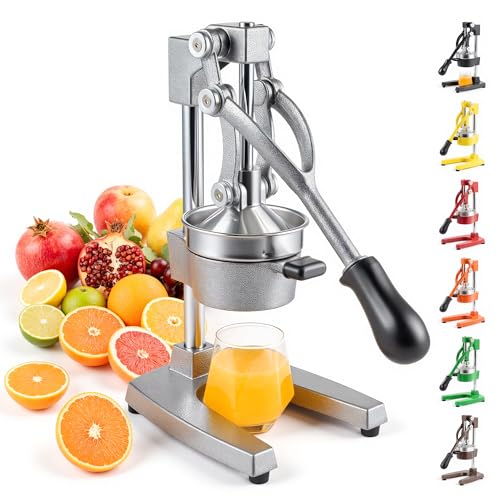
- Reinforced cast-iron manual construction
- Countertop-suction base and ergonomic handle
- Removable stainless steel strainer and funnel
Best For: Rugged manual pressing of citrus and pomegranates
Flexible Countertop Pick
Cuisinart Pulp Control Citrus Juicer

- Three adjustable pulp settings
- Handles limes through grapefruits
- Dishwasher-safe parts
Best For: Home kitchens making repeated batches with customized pulp
Manual Heavy-Duty Pick
ROVSUN Commercial Citrus Press
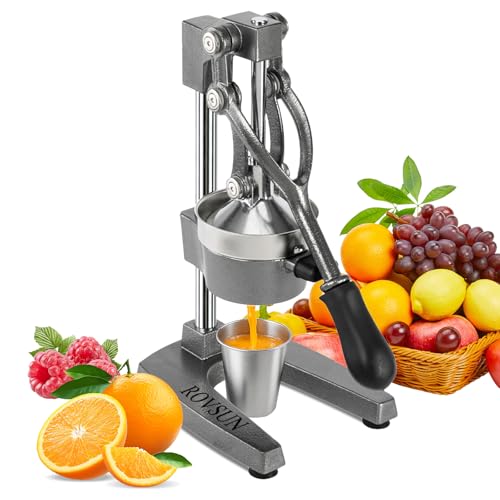
- Lever-assisted high-yield pressing
- Cast iron with 304 stainless steel strainer
- Handles citrus and pomegranates
Best For: Manual batch juicing in restaurants, bars, and home settings
High-Volume Commercial Pick

- Processes up to 20 oranges per minute
- Automatic peeling, juicing, and filtering
- Detachable parts and pull-out filter box
Best For: Commercial operations requiring rapid orange juicing
Compact Commercial Pick – Waring BJ120C Citrus Juicer
If you need citrus juicers for large batches but have limited counter space, the Waring BJ120C is a practical electric option. Its universal reamer handles different citrus fruits and is rated for up to 120 oranges per hour.
Best For: Small bars, cafés, restaurants, and compact prep areas that need steady electric juicing.
Pros:
- Rated to juice up to 120 oranges per hour.
- Compact 7.25-inch-square footprint fits smaller workspaces.
- Heavy-duty die-cast base and vibration-dampening feet support quiet, stable operation.
- Universal reamer works with multiple types of citrus.
Cons:
- Its 1-quart capacity is smaller than that of higher-volume automatic machines.
- Dishwasher-safe care is convenient, but the unit has only one speed.
The Waring is a strong middle ground for businesses that want commercial-oriented construction and useful batch capacity without a large machine. It is less suitable when continuous, high-volume processing is the priority.
Heavy-Duty Manual Choice – Nemco 55850 Citrus Juicer
For citrus juicers for large batches without relying on electricity, the Nemco 55850 uses a manual crank and rack-and-pinion system to apply consistent pressure. Its commercial metal construction is designed for repeated use in restaurants and cafés.
Best For: Restaurants, cafés, juice bars, and kitchens that prefer durable manual operation.
Pros:
- Stainless steel rack-and-pinion mechanism helps deliver uniform pressure.
- Aluminum and stainless steel construction is suited to heavy-duty use.
- Removable strainer cone simplifies cleaning and maintenance.
- Ergonomic handle is designed to reduce strain during operation.
Cons:
- Manual operation requires physical effort for large quantities.
- Hand-wash-only care takes more work than dishwasher-safe alternatives.
- Its tall design may need dedicated counter or mounting space.
The Nemco is a dependable choice when durability, control, and power-free operation matter most. For the fastest unattended throughput, an electric commercial model will be more convenient.
Highest-Volume Electric Pick – VEVOR Commercial Orange Juicer
When your operation needs citrus juicers for large batches, the VEVOR Commercial Orange Juicer offers a substantially higher stated capacity than compact models. Its semi-automatic system is rated for 132 to 176 pounds of citrus per hour and uses multiple rotating shafts for pressing.
Best For: Restaurants, beverage shops, supermarkets, fruit stores, and other high-volume service settings.
Pros:
- Processes a stated 132–176 pounds of citrus per hour.
- Four rotating shaft assemblies support physical pressing and a stated yield above 80%.
- Large fruit basket allows refilling during operation.
- Adjustable fitting accommodates different fruit sizes and includes separate juice and peel collection paths.
Cons:
- At 51.4 pounds, it is considerably heavier than compact juicers.
- Its 21.65-inch height and larger footprint require substantial counter space.
- Hand-wash-only care may make cleanup more involved.
The VEVOR is the throughput-focused option in this group, especially for operations serving juice continuously. It is best considered when available space and heavier equipment are acceptable trade-offs for volume.
Small-Batch Home Option – BLACK+DECKER CJ625 Citrus Juicer
The BLACK+DECKER CJ625 is a compact electric choice for buyers who want citrus juicers for large batches at a household scale. Its 32-ounce container, pressure activation, and adjustable pulp control make it practical for recipes and everyday juice preparation.
Best For: Home kitchens and small batches where easy measuring, pouring, and cleanup are priorities.
Pros:
- 32-ounce clear container includes measurement markings.
- Auto-reversing cones are designed to maximize extraction.
- Adjustable pulp control and removable pulp basket offer serving flexibility.
- Dishwasher-safe parts and a drip-free pour spout simplify cleanup and serving.
Cons:
- Its household-sized container is not intended for commercial-scale throughput.
- The plastic construction is less suited to heavy-duty service than commercial metal models.
- It is designed around orange use rather than broad commercial citrus processing.
The CJ625 is convenient and space-efficient for home users, but it should not be confused with a continuous-use commercial machine. Choose it when batch size is modest and user-friendly features matter more than maximum capacity.
Commercial Power Pick – Hamilton Beach 932 Manual Citrus Juicer
For citrus juicers for large batches, the Hamilton Beach Commercial 932 is a sturdy manual option built for repeated pressing. Its high-force extractor arm is designed to maximize juice output while its commercial-grade construction and stable feet help it stay secure during use.
Best For: High-volume home bars, kitchens, and food-service settings that prefer a durable manual press.
Pros:
- Extractor arm exerts up to 2,000 pounds of force for efficient juice extraction.
- Metal components and enamel finish resist wear from citrus acids.
- Sure Grip feet help prevent tipping during pressing.
- Removable stainless steel strainer cone and ABS funnel simplify cleaning.
Cons:
- Manual operation requires physical effort for every fruit.
- Hand-wash-only care may add cleanup time.
- Its 8-fluid-ounce listed capacity is better suited to pressing into a separate container than storing a large batch.
The 932 is a strong choice when durability, leverage, and dependable extraction matter more than automation. NSF certification also makes it especially appealing for users focused on food-service-oriented construction.
Effortless Electric Option – Eurolux Premium Electric Orange Juicer
When choosing citrus juicers for large batches, the Eurolux Premium Electric Orange Juicer reduces repetitive hand pressure with one-touch operation. Its 120-watt motor, auto-reversing action, and integrated filter make it a practical countertop choice for frequent orange and lemon juicing.
Best For: Users who want convenient electric pressing with less manual effort and straightforward pulp and seed filtering.
Pros:
- Quiet, energy-efficient 120-watt motor is designed for powerful extraction.
- Soft-grip handle starts the juicing cycle with light pressure.
- One-size-fits-most cone accommodates different citrus shapes and sizes.
- Integrated filter captures seeds and unwanted residue, while parts are dishwasher safe.
Cons:
- It requires access to a power outlet.
- The design is larger than some compact countertop juicers.
- The supplied notes identify lemons and oranges but do not specify grapefruit or pomegranate compatibility.
The Eurolux is a convenient batch-juicing solution for anyone who values speed and reduced hand strain. Its automatic controls and dishwasher-safe parts make it easier to fit repeated juicing into a busy routine.
Heavy-Duty Hand Press – CO-Z Commercial Grade Citrus Juicer
The CO-Z manual press is built for citrus juicing sessions where leverage and stability are priorities. For citrus juicers for large batches, its reinforced cast-iron body, suctioning base, and long ergonomic handle provide a solid setup for pressing oranges, lemons, limes, grapefruit, and pomegranates.
Best For: Home users, cocktail makers, and small-scale commercial setups that want a rugged manual press for varied soft or pulpy fruit.
Pros:
- Reinforced cast-iron construction provides substantial pressing strength.
- Base suctions tightly to the countertop for added stability.
- Food-grade 304 stainless steel parts contact the juice.
- Removable strainer and funnel support easier emptying and cleaning.
Cons:
- At about 6 kilograms, it is relatively heavy to move.
- Manual pressing can become tiring during extended batches.
- Its 0.6-liter listed capacity may require frequent emptying when producing large quantities.
The CO-Z combines strong leverage with a stable footprint, making it well suited to repeated pressing without relying on electricity. It is a particularly versatile pick if your batches include pomegranates and other pulpy fruit alongside standard citrus.
Flexible Countertop Pick – Cuisinart Pulp Control Citrus Juicer
For home cooks comparing citrus juicers for large batches, the Cuisinart CCJ-500P1 offers powered pressing, adjustable pulp control, and compatibility with fruit from small limes through large grapefruits. Its 12-ounce capacity is better suited to repeated countertop use than continuous commercial service.
Best For: Home kitchens that want adjustable pulp levels and broad citrus-size compatibility.
Pros:
- Three pulp settings—low, medium, and high—support customized juice texture.
- Auto-reversing cone and final-spin feature help extract more juice.
- Dishwasher-safe parts simplify cleanup.
- Extra-long snap-up spout helps accommodate multiple glasses.
Cons:
- The 12-ounce capacity requires frequent emptying during larger runs.
- Its 25-watt maximum power is less suited to commercial-scale throughput.
- Dishwasher-safe components still require disassembly after use.
This is a practical choice when batch juicing means preparing several servings at home rather than running a juice bar. The pulp adjustment and fruit-size range add versatility, while the compact countertop format keeps it approachable for everyday use.
Manual Heavy-Duty Pick – ROVSUN Commercial Citrus Press
For citrus juicers for large batches without relying on a motor, the ROVSUN commercial hand press uses a long lever and cast-iron construction to produce high-yield juice. It is designed for restaurants, bars, parties, families, and other settings where repeated manual pressing is practical.
Best For: Users who want a sturdy manual press for citrus and pomegranates without rubbing the rind.
Pros:
- Lever design amplifies pressure to help minimize wasted juice.
- Heavy-duty cast iron and a 304 stainless steel strainer support frequent use.
- Works with oranges, grapefruits, lemons, limes, and pomegranates.
- Removable strainer cone and funnel support cleanup.
Cons:
- Hand-wash-only care takes more effort than dishwasher-safe alternatives.
- Manual operation may be slower for very high-volume production.
- At 6.1 kg, it is substantial to move or store.
The ROVSUN is a strong fit when juice quality, durability, and high extraction matter more than push-button convenience. Its manual action avoids rind rubbing, but large batches will still require hands-on labor.
High-Volume Commercial Pick – VEVOR 120W Orange Juicer
Among citrus juicers for large batches, the VEVOR commercial orange juicer is built for the highest throughput here, combining automatic peeling, juicing, and filtering with a stated capacity of up to 20 oranges per minute. Its large footprint and 81.4-pound weight make it a dedicated commercial appliance.
Best For: Grocery stores, restaurants, fruit shops, bars, and beverage businesses needing rapid orange processing.
Pros:
- 120W motor and textured juicing wheel support up to 20 oranges per minute.
- Large feed chute accepts fruit measuring about 2.2–3.2 inches in diameter.
- 304 stainless steel and detachable parts support thorough cleaning.
- Automatic stop activates when the transparent cover is opened.
Cons:
- At 25.59 inches wide and 81.4 pounds, it requires substantial dedicated space.
- Hand-wash-only care demands regular manual cleaning.
- Its commercial capacity may be excessive for occasional household use.
This is the most suitable option for sustained, high-volume service, especially when speed and automated processing outweigh portability. Confirm available counter space and cleaning workflow before choosing it for a smaller operation.
How We Picked the Best Citrus Juicers for Large Batches
We focused on the features that matter when processing repeated loads of oranges, lemons, limes, grapefruits, or similar fruit. The selection includes electric and manual models with different throughput levels, so buyers can compare convenience against control and operating cost.
Our main considerations were stated capacity, motor or pressing design, construction quality, pulp and seed management, cleaning requirements, footprint, and suitability for commercial or home use. We also considered whether each juicer supports multiple fruit sizes and whether its controls are practical during extended sessions.
Quick Comparison
| Type | Best For | Main Advantage | Potential Trade-Off |
|---|---|---|---|
| Commercial electric | High-volume service | Fast, consistent output | Higher price and more parts to clean |
| Compact electric | Busy kitchens and small events | Convenient pressure-activated operation | Usually lower sustained capacity |
| Manual lever press | Cafés, bars, and occasional batches | Strong extraction without electricity | Requires physical effort |
| Manual crank juicer | Controlled batch juicing | Simple construction and low maintenance | Slower than powered equipment |
Key Buying Factors for Citrus Juicers for Large Batches
Capacity and Speed
Check the manufacturer’s claimed hourly or per-minute output, but treat it as an upper limit rather than a guarantee. Actual speed depends on fruit size, cutting time, loading, pulp removal, and how often the machine needs to rest. For a juice bar or event, prioritize a model designed for continuous or repeated operation.
Electric Motor or Manual Press
Electric juicers reduce labor and are generally the better choice for frequent, high-volume service. Manual presses can deliver excellent leverage and require fewer electrical components, making them useful where noise, portability, or simplicity matters. They also provide more direct control over each piece of fruit.
Yield, Pulp Control, and Fruit Compatibility
Look for adjustable pulp settings or removable strainers if different customers prefer different textures. A broad reamer or adaptable press should accommodate the fruit sizes you use most often. Confirm that the design works with grapefruits and larger oranges if those are part of your menu.
Materials and Cleanup
Stainless steel, acid-resistant finishes, and sturdy cast-metal frames are valuable for repeated exposure to citrus juice. Removable cones, strainers, and bowls make cleanup faster. Dishwasher-safe components are convenient, but always verify which parts can safely go in the dishwasher.
Footprint and Safety
Measure your counter and allow room to load fruit and remove the collection container. Non-slip feet, a stable base, protected moving parts, and an easy-to-grip handle help prevent spills and fatigue during long sessions.
Who Should Buy Which Citrus Juicers for Large Batches?
Choose a commercial electric machine if you need the fastest workflow for a café, restaurant, catering operation, or frequent event service. A compact electric model is a practical fit for households and smaller businesses that want push-button convenience without a large commercial footprint.
Choose a heavy-duty manual press when reliability, quiet operation, and low maintenance are more important than maximum speed. A manual crank model suits buyers who want controlled extraction and do not mind doing more of the work themselves. For occasional home batches, prioritize easy cleaning, adjustable pulp control, and storage-friendly dimensions over maximum advertised throughput.